Meloxicam: Uses, Side Effects, Dosage & Safety
Meloxicam is one of the most commonly prescribed arthritis medicines in the United States. It is also one of the most misunderstood. Some people think it is simply a stronger ibuprofen. Others assume it is gentle on the stomach because it is a “newer” kind of anti-inflammatory. Neither idea holds up well. This article covers what meloxicam does, how the usual doses work, which side effects are routine and which are not, and the safety details that often get lost in a pharmacy handout.
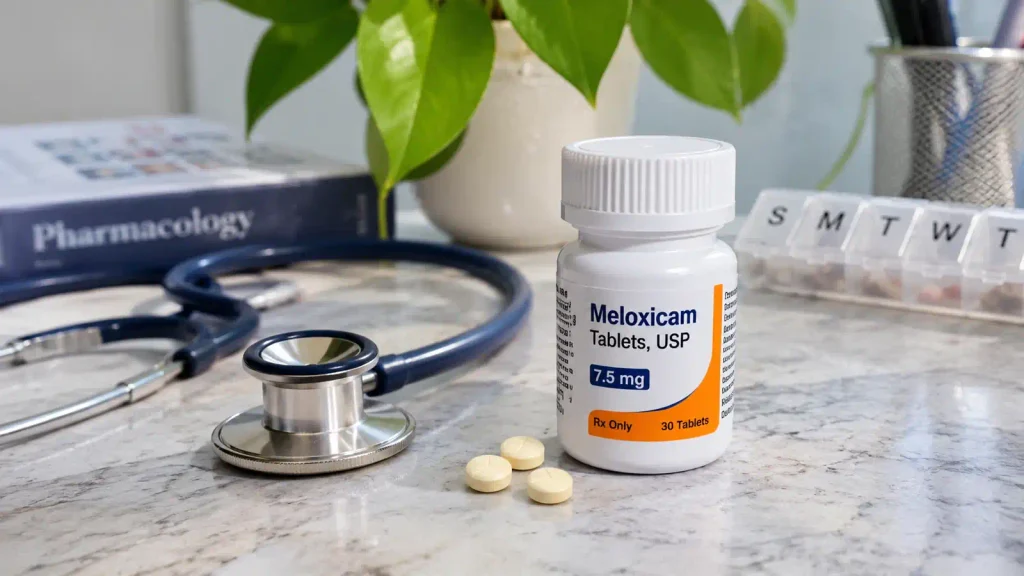
Meloxicam is a prescription NSAID (nonsteroidal anti-inflammatory drug) used mainly for osteoarthritis, rheumatoid arthritis, and juvenile arthritis. It eases pain and swelling but does not cure arthritis. Adults usually start at 7.5 mg once a day, and the labeled maximum for tablets is 15 mg a day. Like every NSAID, it carries serious warnings for the stomach, heart, and kidneys, so the lowest dose that works, for the shortest time, is the standard approach. Don’t combine it with ibuprofen, naproxen, or aspirin unless your prescriber says so.
What meloxicam is, and what it isn’t
Meloxicam belongs to the same drug class as ibuprofen (Advil, Motrin) and naproxen (Aleve). It lowers the body’s production of the chemicals that drive pain, swelling, and stiffness. The brand name is Mobic, and generic tablets and an oral liquid are widely available.
According to Mayo Clinic’s drug information, meloxicam does not cure arthritis. It helps only while you keep taking it. Other forms exist, including an injectable version for short-term pain in adults. Some earlier versions, such as the Vivlodex capsule and the Qmiiz dissolving tablet, are listed as discontinued by Drugs.com. The tablet and oral suspension are what most people receive.
What doctors prescribe it for
The FDA-labeled uses are osteoarthritis, rheumatoid arthritis, and juvenile rheumatoid arthritis in children 2 years and older, as outlined by MedlinePlus. It is sometimes used for ankylosing spondylitis too. You may also hear of it prescribed for back pain or other aches. Those uses go beyond the labeling and are a judgment call between you and your prescriber.
For osteoarthritis, the 2019 American College of Rheumatology and Arthritis Foundation guideline strongly recommends oral NSAIDs for hand, hip, and knee disease. For the knee and hand, topical NSAIDs are generally considered first because far less of the drug reaches the rest of the body. If you have knee arthritis and are worried about oral medication, a topical option is a reasonable question for your appointment. Pairing it with movement and strengthening work also helps, and our guide to early osteoarthritis symptoms covers what to watch for.
Why it is taken once a day, and why patience matters
Meloxicam lingers in the body. FDA labeling puts its half-life, the time it takes for blood levels to fall by half, at roughly 15 to 20 hours. A tablet taken on an empty stomach reaches its peak in about four to five hours, and steady levels build up over about five days of regular dosing.
That pattern explains two common experiences:
- It isn’t a take-it-when-it-hurts pill. Pain relief often begins within a day, but for chronic joint conditions the full effect can take several days to a couple of weeks, according to Drugs.com.
- Timing within the day is flexible. MedlinePlus says to take it at the same time daily, with or without food. Drugs.com notes that food may help if it upsets your stomach.
Usual doses on the label
Your own prescription may differ. Don’t change your dose without your prescriber’s guidance.
| Form and condition | Typical starting dose | Usual ceiling |
|---|---|---|
| Tablets or suspension, adults (osteoarthritis or rheumatoid arthritis) | 7.5 mg once daily | 15 mg once daily |
| Capsules, adults (osteoarthritis) | 5 mg once daily | 10 mg once daily |
| Suspension, children 2 and older (juvenile arthritis) | 0.125 mg per kg once daily | 7.5 mg daily |
Doses come from Mayo Clinic and Drugs.com.
A few practical points deserve attention:
- Milligram strengths don’t transfer between forms. A capsule dose is not the same as a tablet dose.
- Mayo advises sticking with the brand or manufacturer your prescriber chose, since different products may not behave identically. If a refill looks different, ask the pharmacist.
- Measure the liquid with a proper oral syringe or dosing cup, not a kitchen spoon.
- If you miss a dose, take it when you remember unless the next dose is close. Skip it in that case. Don’t double up.
Side effects: the routine ones and the ones to act on
Common effects are mostly digestive: heartburn, indigestion, stomach pain, nausea, diarrhea, constipation, and gas. Dizziness, a sore throat, and cold-like symptoms are also listed. These are worth mentioning to your prescriber if they are strong or persistent.
Stop and call your doctor promptly for:
- Black or tarry stools, blood in the stool, or vomit that looks like coffee grounds, which can signal stomach or intestinal bleeding
- Swelling in the legs, ankles, or abdomen, rapid weight gain, or new shortness of breath, which can point to fluid retention or heart strain
- Little or no urine, new swelling, or unusual tiredness, which can point to kidney trouble
- Yellow skin or eyes, dark urine, or pain in the upper right abdomen, which can point to liver trouble
- Skin rash of any kind, even a mild one, along with blistering, peeling, or sores in the mouth. Serious skin reactions are uncommon but documented.
- Muscle weakness, an irregular heartbeat, or tingling around the lips, which Mayo links to high potassium
Call 911 for chest pain, weakness on one side of the body, slurred speech, trouble breathing, or swelling of the face or throat.
The “easy on the stomach” idea, in context
Meloxicam’s reputation comes from real data, but the headline is often stretched. A pooled analysis of 28 trials and about 24,000 patients, summarized in American Family Physician, found fewer serious stomach and intestinal complications with 7.5 mg of meloxicam than with diclofenac, naproxen, or piroxicam. At 15 mg, the difference held up only against piroxicam. Most of those trials lasted 60 days or less, and the absolute differences were under one percent. The reviewers also noted that a direct comparison with ibuprofen was still missing.
The label itself still carries a boxed warning for ulcers and bleeding, which can occur without warning symptoms. Risk climbs with age, past ulcers, long-term use, alcohol, and certain other medicines. Doctors sometimes add a stomach-protecting medicine for higher-risk patients. If that comes up, our overview of omeprazole explains how that class of drug works.
The heart tells a similar story. The FDA has said that NSAIDs can raise the chance of heart attack or stroke, that this can happen within the first few weeks, and that the risk rises with higher doses and longer use. Newer information also made it unclear that any single NSAID is clearly safer than another. People with high blood pressure should know NSAIDs can raise it, and home readings are useful. Our guide to blood pressure readings explains what the numbers mean.
Who needs extra caution
Tell your prescriber about any of the following before starting:
- A past allergic reaction, hives, or asthma attack after aspirin or another NSAID. Asthma with frequent nasal congestion or polyps deserves a mention too.
- A heart attack, stroke, heart failure, high blood pressure, or fluid retention. Do not use meloxicam around heart bypass surgery (CABG), and avoid it after a recent heart attack unless your doctor directs otherwise.
- Kidney disease, liver disease, or a history of ulcers or bleeding
- Pregnancy, plans to become pregnant, or breastfeeding. The FDA advises against NSAIDs at 20 weeks of pregnancy or later unless a health professional specifically directs it, because of possible kidney problems in the baby and low amniotic fluid. Meloxicam can also delay ovulation, which matters for anyone trying to conceive.
- Hereditary fructose intolerance, since the oral suspension contains sorbitol
Older adults are more prone to stomach, heart, and kidney complications, so doses and monitoring are often adjusted.
Interactions people overlook
The most common mistake isn’t an exotic drug interaction. It is stacking NSAIDs. Meloxicam plus over-the-counter ibuprofen, naproxen, or aspirin multiplies the risks without adding clear benefit. Many cold, flu, and “PM” combination products contain an NSAID, so read the active ingredients. Acetaminophen (Tylenol) is a different type of drug and not an NSAID, but your pharmacist can confirm what combination suits you. We compare the two in acetaminophen vs. NSAIDs.
Other medicines that call for a conversation:
- Blood thinners such as warfarin, and oral steroids such as prednisone
- Antidepressants in the SSRI and SNRI families, since combining them with NSAIDs raises bleeding risk
- Blood pressure medicines, including ACE inhibitors, ARBs, and diuretics
- Lithium, methotrexate, and cyclosporine
- Sodium polystyrene sulfonate (Kayexalate), which should not be taken with the oral suspension
Alcohol deserves a place on this list. Drinking while taking meloxicam raises the chance of stomach bleeding.
Monitoring and long-term use
Meloxicam has no fixed time limit. Some people take it for months or years for arthritis. The FDA-backed principle is the lowest effective dose for the shortest time that controls symptoms. Mayo notes that blood and urine tests may be needed to check for effects on the kidneys and liver, and regular check-ins are part of safe use.
Good questions to bring to an appointment:
- Why meloxicam rather than a topical NSAID or another option for my joint?
- What is the lowest dose that is likely to work, and how long should I plan on it?
- Given my age and other medicines, should I have stomach protection?
- How will you check my blood pressure and kidneys?
- Which over-the-counter products should I avoid?
If you are comparing choices, our pages on celecoxib and other prescription NSAIDs cover how they differ.
If someone takes too much
Overdose can cause drowsiness, nausea, vomiting, stomach pain, black or bloody stools, difficulty breathing, and in severe cases seizures. Call Poison Control at 1-800-222-1222 or use Poison Help online. If the person has collapsed, is having a seizure, or can’t be awakened, call 911.
FAQ
How long does meloxicam take to work?
Many people notice some relief within a day, but for osteoarthritis or rheumatoid arthritis the full benefit can take several days to two weeks. Blood levels need about five days of daily dosing to level off, according to FDA labeling.
Can I take meloxicam with ibuprofen or naproxen?
Generally no. They are all NSAIDs, and combining them raises the risk of stomach bleeding and kidney problems. See our pages on ibuprofen and naproxen to see how they compare. Ask your prescriber or pharmacist before adding any pain reliever.
Should I take it in the morning or at night?
Either can work. The key is picking one time and sticking with it. MedlinePlus says it can be taken with or without food, and food may ease stomach upset.
Is meloxicam a steroid, an opioid, or a muscle relaxant?
None of these. It is an NSAID, in the same family as ibuprofen but available only by prescription.
Can I drink alcohol while taking it?
Alcohol raises the risk of stomach bleeding with NSAIDs, so it is best to discuss your drinking habits with your prescriber.
Does meloxicam raise blood pressure?
It can. Mayo Clinic lists increased blood pressure among the possible effects and suggests home monitoring for some people. Our guide to blood pressure readings explains when a number is a concern.
Is it safe during pregnancy?
The FDA recommends avoiding NSAIDs at 20 weeks or later unless a health professional specifically advises them. Anyone pregnant or planning pregnancy should talk with their doctor first. Details are in the FDA communication.
What should I do about stomach upset?
Taking it with food can help, and persistent heartburn or pain is worth reporting. Black stools or bloody vomit need prompt medical attention. Our omeprazole article explains one common stomach-protection option your doctor might discuss.