
How to Stop Snoring: 7 Things That May Help
Snoring is often dismissed as a harmless, slightly embarrassing nuisance or a late-night punchline between sleep partners. Yet for millions of adults, habitual snoring disrupts restorative sleep, leads to persistent daytime fatigue, and strains relationships.
The sound itself is mechanical: during sleep, the muscles supporting the soft palate, uvula, and tongue relax. As air moves past these relaxed tissues during breathing, the narrowed passage causes them to flutter and vibrate.
While occasional snoring happens to almost everyone—particularly during a head cold or after a night out—regular snoring requires a structured approach. Several evidence-based interventions can reduce airway vibration, provided the underlying cause is uncomplicated snoring rather than an undiagnosed sleep disorder.
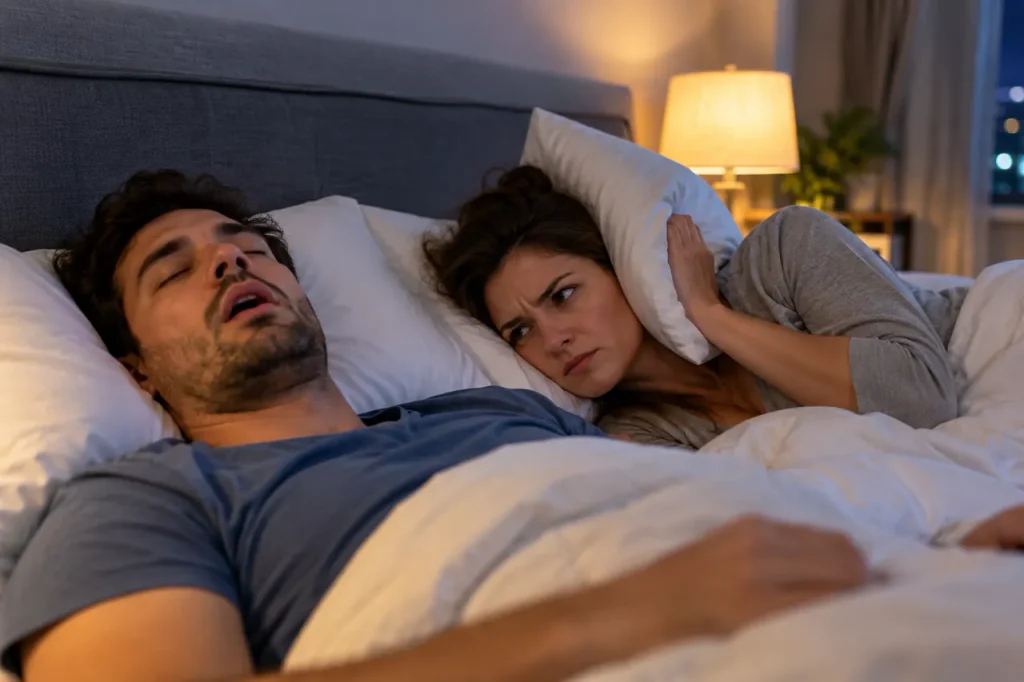
Table of Contents
Primary Snoring vs. Obstructive Sleep Apnea
Before testing lifestyle adjustments, it is critical to determine what type of snoring you are dealing with. Medical science divides snoring into two primary categories:
- Primary Snoring (Simple Snoring): Airway resistance causes the soft tissues of the throat to vibrate, but air still flows into the lungs continuously. Blood oxygen levels remain stable, and sleep architecture is not repeatedly fractured by survival reflexes.
- Obstructive Sleep Apnea (OSA): The airway does not merely narrow; it repeatedly collapses entirely or partially. These breath pauses (apneas or hypopneas) deprive the brain and body of oxygen, triggering brief awakenings to reopen the airway—often dozens or hundreds of times per night.
Untreated OSA is not a cosmetic issue. Over time, it significantly increases the risk of chronic hypertension, cardiac arrhythmias, type 2 diabetes, stroke, and motor vehicle accidents caused by microsleeps. Lifestyle measures alone rarely resolve moderate-to-severe OSA.
7 Things That May Help Stop Snoring
For simple snoring or mild, positional airway resistance, targeted adjustments can noticeably reduce tissue vibration by keeping nasal passages open and the upper airway clear.
1. Shift from Back Sleeping to Side Sleeping (Positional Therapy)
Sleeping on your back (supine) is the most common mechanical trigger for snoring. When lying flat, gravity pulls the base of the tongue and the relaxed soft palate backward against the posterior pharyngeal wall, substantially narrowing the airway.
Shifting to your side (lateral position) allows the tongue to fall forward naturally, keeping the airway lumen open. If you naturally roll onto your back during deep sleep, consider using positional aids:
- A contoured body pillow placed behind the back.
- Positional sleep wedges.
- Wearable positional vibratory sensors that gently prompt you to roll over when supine sleep is detected.
2. Achieve and Maintain a Healthy Weight
Excess weight is a well-established contributing factor to snoring, specifically weight carried around the neck and upper chest. Fatty tissue deposits around the pharynx and base of the tongue increase external pressure on the airway, making it more prone to collapse when muscles relax at night.
Clinical studies demonstrate that even modest weight reduction—around 5% to 10% of total body weight—can reduce pharyngeal fat deposits, decrease airway collapsibility, and significantly lessen snoring intensity.
3. Eliminate Evening Alcohol and Sedating Medications
Alcohol is a potent central nervous system depressant and a systemic muscle relaxant. Drinking within three to four hours of bedtime causes the muscles of the throat and tongue to relax far more deeply than they would during natural sleep, blunting the body’s natural defense against airway narrowing.
Alcohol also inflames upper airway mucosal membranes, which further restricts airflow. Sedatives, muscle relaxants, and certain prescription sleeping medications can exert a similar relaxant effect on the upper airway musculature. Discuss these medications with your doctor before making changes.
4. Clear Nasal Congestion Before Sleep
Breathing through the nose creates gentle negative pressure in the throat. When nasal passages are congested due to allergies, sinus inflammation, or a deviated septum, you are forced to breathe through your mouth. Mouth breathing causes the lower jaw to fall backward, compressing the throat and drastically increasing tissue vibration.
Targeted approaches to improve nasal patency include:
- Saline nasal irrigation: Using a neti pot or sinus rinse bottle with distilled or sterile water before bed to flush out allergens and mucus.
- Over-the-counter nasal strips: External adhesive strips lift and open the nasal valve area mechanically, which can improve nasal air intake without medication.
- Non-sedating antihistamines or steroid nasal sprays: If chronic allergic rhinitis is the primary driver, talk to a clinician about targeted sprays. Avoid routine use of over-the-counter decongestant sprays (such as oxymetazoline) for more than three to five consecutive days, as they cause severe rebound congestion (rhinitis medicamentosa).
5. Elevate the Head of Your Bed
Propping your head up with extra pillows often bends the neck, which can actually kink the trachea and worsen airway restriction.
Instead, elevate the entire upper torso by 4 to 6 inches. This can be accomplished using an adjustable bed base or placing sturdy bed risers under the two front legs of your bed frame. Elevating the head of the bed utilizes gravity to prevent the tongue from sliding back and reduces acid reflux—a common nocturnal irritant that can inflame throat tissues.
6. Practice Oropharyngeal Exercises (Myofunctional Therapy)
The upper airway is surrounded by complex muscle groups that control the tongue, soft palate, and pharyngeal walls. When these muscles lose tone, they collapse more easily during sleep.
Myofunctional therapy involves targeted daily exercises designed to tone these structures:
- Pushing the tip of the tongue against the hard palate and sliding it backward.
- Sucking the entire tongue upward against the roof of the mouth and holding for 10 seconds.
- Pronouncing vowel sounds repeatedly with exaggerated lip and jaw movements.
A 2015 randomized study published in CHEST demonstrated that practicing myofunctional exercises for 20 minutes daily over three months reduced snoring frequency by 36% and snoring power by 59% in patients with mild-to-moderate airway collapse.
7. Explore Custom Oral Appliances
If simple behavioral changes do not resolve snoring, an over-the-counter boil-and-bite mouthguard is rarely the answer; these devices often fit poorly, slip out, and cause temporomandibular joint (TMJ) discomfort.
Instead, consult a dentist trained in dental sleep medicine for a custom Mandibular Advancement Device (MAD). These appliances fit over the upper and lower teeth, gently holding the lower jaw and tongue slightly forward throughout the night. This mechanical forward stabilization maintains space in the back of the throat, offering a reliable, clinically validated solution for primary snorers and select individuals with mild-to-moderate sleep apnea who cannot tolerate continuous positive airway pressure (CPAP).
Evaluating Popular Snoring Gadgets
The consumer sleep market is flooded with quick-fix snoring solutions. Evidence varies substantially across product categories:
| Product / Method | How It Works | Evidence Level | Best Suited For |
| External Nasal Strips | Mechanically pulls open nasal valve | Moderate | Temporary congestion or nasal valve collapse |
| Mouth Taping | Keeps lips closed to force nasal breathing | Limited / Mixed | Mild mouth breathing; unsafe if nasal passage is blocked or in severe OSA |
| Custom Oral Appliance (MAD) | Shifts lower jaw and tongue forward | Strong | Primary snoring and mild-to-moderate OSA |
| Pillow Mists / Throat Sprays | Lubricates or scents the throat | Poor / Anecdotal | Not supported by clinical guidelines |
| Positional Sleep Aids | Prevents rolling onto the back | Strong | Positional snorers (worse on back) |
Red Flags: When Snoring Points to Sleep Apnea
Snoring should never be ignored if it is accompanied by systemic daytime symptoms or observed breathing irregularities.
Consult a board-certified sleep specialist or primary care physician for a formal sleep study (polysomnography or home sleep apnea testing) if you or your partner observe any of the following:
- Observed pauses in breathing: Witnessed gasping, choking, or snorting sounds that interrupt loud snoring.
- Excessive daytime sleepiness: Falling asleep unintentionally during passive activities, meetings, or while driving.
- Morning headaches: Frequent, dull headaches upon waking, caused by carbon dioxide retention and overnight oxygen fluctuations.
- Waking up with dry mouth or sore throat: An indicator of chronic, heavy mouth breathing.
- Nocturia: Waking multiple times per night to urinate without a clear urological cause.
- Resistant high blood pressure: Hypertension that remains poorly controlled despite multiple medications.
Sources
- American Academy of Sleep Medicine (AASM). “Snoring: Overview & Facts.” Updated 2023.
- Camacho, M., et al. “Myofunctional Therapy to Treat Obstructive Sleep Apnea: A Systematic Review and Meta-analysis.” Sleep, 2015; 38(5): 669–675.
- Ieto, V., et al. “Effects of Oropharyngeal Exercises on Snoring: A Randomized Trial.” CHEST, 2015; 148(3): 683–691.
- National Heart, Lung, and Blood Institute (NHLBI). “What Is Sleep Apnea?” National Institutes of Health, 2022.
- Ramar, K., et al. “Clinical Practice Guideline for the Treatment of Obstructive Sleep Apnea and Snoring with Oral Appliance Therapy.” Journal of Clinical Sleep Medicine, 2015; 11(7): 773–827.