ADHD Symptoms in Children: Early Signs & Types
Every child has days when sitting still feels impossible, instructions go in one ear and out the other, or impulses win out over patience. High energy, daydreaming, and brief attention spans are natural parts of growing up. But when a child’s challenges with focus, restlessness, or self-control are persistent, intense, and disrupting their school performance, friendships, and home life, parents often wonder whether something more is going on.
Attention-deficit/hyperactivity disorder (ADHD) is one of the most common neurodevelopmental conditions diagnosed in childhood. Understanding how its symptoms manifest, how it presents across different personalities and sexes, and how it differs from typical childhood behavior can help you decide when it is time to seek professional guidance.
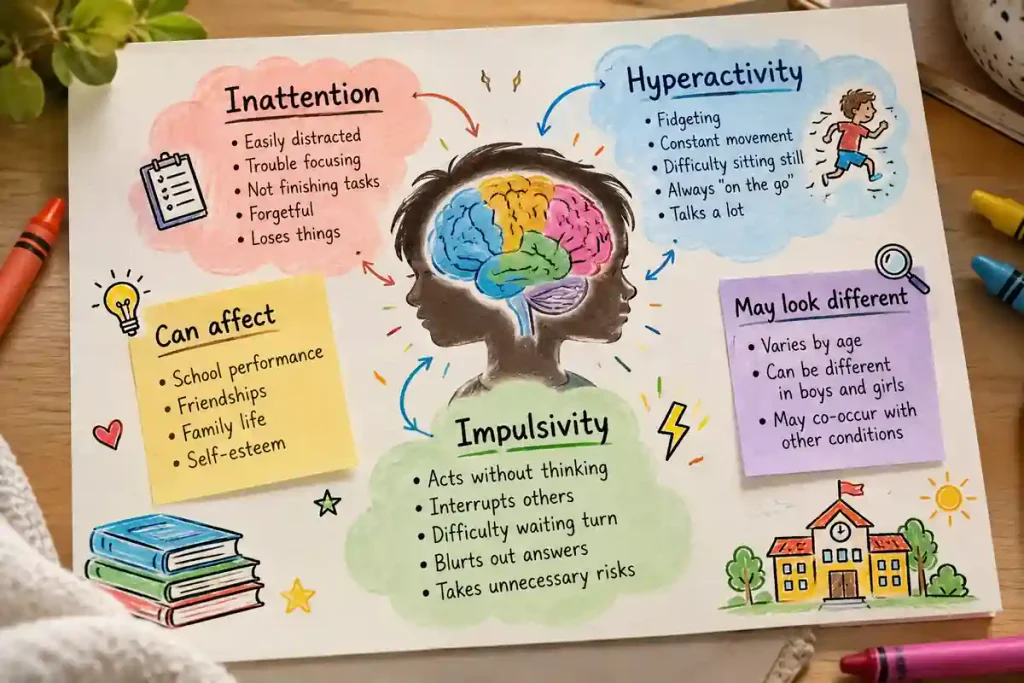
ADHD is a neurodevelopmental disorder marked by persistent patterns of inattention, hyperactivity, impulsivity, or a combination of these traits. Unlike occasional childhood restlessness, ADHD symptoms last at least six months, appear in two or more settings (such as home and school), and directly interfere with daily functioning. Diagnosis requires a comprehensive evaluation by a qualified healthcare professional—never an online quiz.
What Is ADHD in Children?
Attention-deficit/hyperactivity disorder is a chronic neurodevelopmental condition that affects how the brain manages executive functions—the mental skills that enable people to plan, focus attention, remember instructions, prioritize tasks, and regulate impulses.
Symptoms typically emerge in early childhood and often persist into adolescence and adulthood. ADHD is not caused by poor parenting, lack of discipline, or a child choosing not to cooperate. Instead, it involves measurable differences in brain development, neural connectivity, and chemical signaling pathways that influence attention regulation and motor activity. Left unaddressed, ADHD can create challenges in academic achievement, self-esteem, peer relationships, and family dynamics.
What Are the Main Symptoms of ADHD?
According to clinical criteria outlined by the American Academy of Pediatrics (AAP) and the Diagnostic and Statistical Manual of Mental Disorders (DSM-5-TR), ADHD symptoms fall into three core categories: inattention, hyperactivity, and impulsivity.
Inattention Symptoms
Children struggling with inattention do not simply lack the ability to pay attention; rather, they struggle to regulate and direct their focus, particularly during repetitive, unstructured, or mentally demanding tasks:
- Frequently making careless mistakes in schoolwork or missing obvious details
- Struggling to sustain attention during lectures, conversations, or lengthy reading
- Appearing not to listen even when spoken to directly
- Difficulty following through on multi-step instructions, often starting tasks but losing focus before finishing
- Persistent trouble organizing assignments, materials, backpacks, and schedules
- Avoiding or resisting tasks that require sustained mental effort, such as homework or classroom projects
- Frequently misplacing essential items, including school supplies, books, eyeglasses, or jackets
- Being easily distracted by unrelated external sights, sounds, or internal thoughts
- Forgetting daily routines, chores, or assigned responsibilities
Hyperactivity Symptoms
Hyperactivity involves excessive, poorly regulated physical energy that does not match the child’s developmental age or the expectations of their environment:
- Fidgeting constantly, tapping hands or feet, or squirming in their seat
- Getting up and wandering when remaining seated is expected, such as in the classroom or at the dinner table
- Running, jumping, or climbing excessively in situations where it is inappropriate
- Struggling to play, read, or engage in leisure activities quietly
- Being constantly “on the go,” acting as if driven by an internal motor
- Talking excessively, often without pausing for conversational turns
Impulsivity Symptoms
Impulsivity reflects difficulty with self-regulation, behavioral inhibition, and delaying gratification:
- Blurting out answers in class before a question has been fully asked
- Significant difficulty waiting their turn during games, lines, or conversations
- Regularly interrupting others, cutting into conversations, or taking over activities without invitation
- Acting on immediate desires without considering safety, rules, or consequences (such as darting into a street or jumping from dangerous heights)
The 3 Types of ADHD
ADHD does not present the same way in every child. Clinicians classify the condition into three specific presentations based on the dominant pattern of symptoms:
- Predominantly Inattentive Presentation: The child displays significant challenges with focus, organization, following instructions, and memory, but exhibits little to no hyperactivity or disruptive behavior. These children are often quiet, daydreamy, and easily overlooked in a busy classroom.
- Predominantly Hyperactive-Impulsive Presentation: The child displays pronounced restlessness, fidgeting, excess energy, and impulsive actions, but retains relatively adequate ability to focus when needed. This is the least common type and is observed more frequently in very young children.
- Combined Presentation: The child meets the diagnostic threshold for both inattention and hyperactivity-impulsivity. This is the most frequently diagnosed form of ADHD in school-age children.
A child’s presentation is not static; it can shift as they grow. For instance, high levels of physical hyperactivity seen in early childhood often evolve into internal restlessness, disorganization, and executive dysfunction by adolescence.
Important Distinction: ADHD vs. Occasional Childhood Behavior
Key Rule: Occasional distractibility, bound-less energy, and impulsive outbursts are normal parts of child development. ADHD is characterized by patterns that are chronic, developmentally inappropriate, present across multiple environments, and cause clear impairment in daily life. Only a qualified healthcare provider can determine whether a child meets clinical diagnostic criteria.
| Typical Childhood Behavior | Behavior That May Warrant Evaluation |
| Gets distracted occasionally during boring tasks | Persistently struggles to sustain focus on age-appropriate work |
| Runs around energetically during active play or recess | Displays continuous motor activity that disrupts structured settings |
| Interrupts conversations from time to time | Frequently interrupts, blurts out, and struggles to wait turns despite reminders |
| Occasionally forgets homework, a jacket, or sports gear | Chronic disorganization; consistently loses essential items daily |
| Struggles to sit through a long movie or family event | Regularly unable to remain seated when expected in class or meals |
| Leaves a chore incomplete when interrupted by a friend | Routinely unable to follow multi-step directions to completion |
Early Signs in Young Children (Ages 3 to 5)
Identifying ADHD in toddlers and preschool-age children is uniquely challenging. Young children naturally have short attention spans, high energy reserves, and developing emotional control.
Occasional tantrums, running in stores, or refusing to sit for storytime are developmentally typical. However, early signs that may suggest a need for professional observation include:
- Sustained inability to engage with a single toy or game for more than a minute or two, even with adult guidance
- Chronic difficulty settling down for naps, bedtime, or quiet time compared to peers
- Extreme, persistent aggression or destructive play when frustrated
- Repeatedly engaging in dangerous behaviors (climbing onto high counters, bolting into parking lots) without learning from past warnings or injuries
- Consistent behavioral feedback from preschool teachers or daycare providers that the child requires continuous one-on-one supervision to prevent disruption or maintain safety
The AAP recommends careful developmental assessment for preschoolers rather than rushed diagnoses, focusing primarily on parent training and behavioral strategies as first-line support.
ADHD Symptoms in Boys vs. Girls
Historically, boys have been diagnosed with ADHD roughly two to three times more often than girls. Research from the National Institute of Mental Health (NIMH) and clinical studies shows this disparity is largely driven by differences in how symptoms typically present rather than an actual absence of the condition in girls.
- Boys are more likely to display externalizing, overt behaviors: visible hyperactivity, impulsivity, physical disruption, and oppositional behaviors. These signs draw immediate attention from parents and teachers.
- Girls are more frequently diagnosed with the predominantly inattentive presentation. Their symptoms tend to be internalizing: quiet daydreaming, social withdrawal, perfectionism, anxiety, or persistent disorganization without classroom disruption.
Because girls with inattentive ADHD often work quietly and try hard to please adults, their academic and emotional struggles are frequently missed until middle school, high school, or adulthood, when executive demands increase dramatically.
Where Do Symptoms Occur and How Long Must They Last?
For a clinician to consider an ADHD diagnosis, symptoms must meet rigorous diagnostic parameters established by clinical guidelines:
- Duration: The symptoms must have been consistently present for at least six consecutive months. A sudden shift in behavior following a family move, divorce, bereavement, or classroom change points toward situational stress rather than ADHD.
- Onset: Several inattentive or hyperactive-impulsive symptoms must have been present before the age of 12.
- Pervasiveness (Multiple Settings): Symptoms cannot occur exclusively in one environment. A child who struggles only at home but excels without issue at school, or a child who acts out only in one specific teacher’s classroom, is unlikely to have ADHD. Impairment must be evident in at least two distinct settings (e.g., home, school, after-school care, or sports teams).
- Functional Impairment: The behaviors must measurably interfere with the child’s academic performance, social relationships, or emotional development.
Conditions That Can Look Like ADHD
Many medical, psychological, and developmental conditions share overlapping symptoms with ADHD. A thorough evaluation must rule out or identify:
- Sleep Disorders: Obstructive sleep apnea, restless legs syndrome, or chronic insufficient sleep can cause daytime hyperactivity, irritability, and severe focus issues.
- Anxiety and Depression: Anxious children frequently appear restless, fidgety, and distracted because their attention is consumed by internal worries.
- Learning Disabilities: A child with undiagnosed dyslexia or dyscalculia may zone out, avoid schoolwork, or act out to divert attention from academic frustration.
- Sensory, Vision, or Hearing Impairments: A child who cannot see the board or process auditory instructions clearly may appear inattentive or disengaged.
- Trauma or Chronic Stress: Adverse childhood experiences, family conflict, or bullying produce hypervigilance that mimics hyperactive and impulsive behaviors.
What Causes ADHD?
The exact underlying cause of ADHD remains complex, but extensive scientific consensus confirms that it is primarily biological and neurodevelopmental:
- Genetics: ADHD is highly heritable. A child with ADHD frequently has a parent, sibling, or close relative with the condition.
- Brain Structure and Function: Neuroimaging research demonstrates subtle differences in the maturation rate, volume, and dopamine signaling pathways of brain regions responsible for executive functioning, particularly the prefrontal cortex and basal ganglia.
- Environmental Risk Factors: Premature birth, low birth weight, prenatal exposure to alcohol, tobacco, or nicotine, and early childhood exposure to environmental toxins such as lead can increase risk.
Dietary myths remain common. Rigorous medical research from major institutions, including the Mayo Clinic, confirms that sugar, artificial food coloring, and screen time do not cause ADHD, though poor sleep and high screen use can exacerbate existing behavioral difficulties.
When Should Parents Talk to a Doctor?
Consider scheduling an evaluation with your child’s pediatrician or family physician if you notice that:
- Inattention, restlessness, or impulsivity is persistent and noticeably out of step with peers of the same age
- School reports or parent-teacher conferences consistently cite difficulty completing assignments, following directions, or staying seated
- Your child is falling behind academically despite normal intellectual capability and effort
- Peer relationships are suffering because of difficulty sharing, frequent interruptions, or emotional dysregulation
- Impulsive behaviors are creating genuine physical safety concerns for the child or others
- The challenges are creating chronic stress, conflict, and exhaustion within the family
What Happens During an ADHD Evaluation?
There is no single blood test, brain scan, or genetic marker that can diagnose ADHD. A legitimate clinical evaluation is a comprehensive, multi-step process:
- Initial Clinical Interview: The pediatrician or specialist takes a detailed medical, family, and developmental history to understand your child’s milestones, health history, and home environment.
- Behavioral Rating Scales: Standardized rating scales (such as the Vanderbilt or Conners assessments) are completed independently by parents and teachers to measure behaviors across settings.
- Medical and Sensory Screenings: The physician performs a physical examination and may order vision and hearing tests to rule out sensory deficits.
- School and Academic Review: Reviewing report cards, standardized testing, and classroom work samples helps assess the real-world academic impact.
- Differential Assessment: The clinician evaluates for possible co-occurring conditions, including anxiety, mood disorders, or learning differences.
How Is ADHD Treated in Children?
Evidence-based treatment for childhood ADHD relies on a multimodal approach tailored to the child’s age, specific challenges, and family preferences:
- Parent Training in Behavior Management: Highly effective behavioral therapy that equips parents with structured strategies, consistent routines, clear positive reinforcement, and effective discipline methods.
- School Interventions: Formal educational accommodations, such as a 504 Plan or an Individualized Education Program (IEP), which can provide extended testing time, preferential seating near the teacher, written task checklists, and movement breaks.
- Medication: Stimulant medications (such as methylphenidate or amphetamine formulations) and non-stimulant medications (such as atomoxetine or guanfacine) help normalize neurotransmitter levels, improving attention span and impulse control under medical supervision.
Treatment Recommendations by Age (AAP Guidelines)
- Preschool-Age Children (Ages 4 to 5): Evidence-based parent training in behavior management and classroom interventions are recommended as the first-line treatment. Medication is generally considered only if behavioral strategies fail to provide sufficient improvement and there is severe functional impairment.
- School-Age Children (Ages 6 to 11): A combination of FDA-approved medication, behavioral parent training, and behavioral classroom accommodations is recommended as the most effective standard of care.
- Adolescents (Ages 12 to 18): Medication is recommended alongside behavioral and organizational skills coaching, with the adolescent actively participating in treatment planning.
How Parents Can Support a Child With ADHD
Beyond formal clinical care, day-to-day household strategies can significantly reduce frustration and support executive functioning:
- Establish Predictable Routines: Keep wake-up, meal, homework, and bedtime schedules consistent every day of the week. Post visual daily schedules where your child can easily see them.
- Break Instructions into Single Steps: Instead of saying, “Clean your room, put on your shoes, and grab your backpack,” offer one clear instruction at a time and ask them to repeat it back.
- Organize the Environment: Designate specific, labeled bins and spots for school supplies, shoes, sports gear, and coats to minimize lost items.
- Catch Them Being Good: Children with ADHD often receive frequent corrective feedback throughout the day. Actively look for opportunities to praise effort, patience, and completed tasks immediately.
- Prioritize Daily Movement and Sleep: Regular aerobic physical activity and a calm, screen-free bedtime routine help regulate energy and support attention.
ADHD and Co-Occurring Conditions
It is common for ADHD to exist alongside other challenges. According to the CDC, approximately two out of three children with ADHD have at least one other co-occurring condition:
- Learning Disabilities: Dyslexia, dysgraphia, or language processing disorders
- Anxiety and Depression: Frequent feelings of worry or sadness stemming from chronic frustration and social difficulty
- Oppositional Defiant Disorder (ODD): A persistent pattern of angry, irritable mood and argumentative behavior toward authority figures
- Sleep Disorders: Difficulty falling asleep, frequent night waking, or morning grogginess
- Autism Spectrum Disorder (ASD): Challenges with social communication and sensory processing
A comprehensive evaluation ensures that all co-occurring issues are identified, allowing for a cohesive treatment plan that addresses the child’s complete needs.
Frequently Asked Questions
What are the first signs of ADHD in children?
Early signs typically involve extreme, persistent restlessness, an inability to focus on quiet activities even with adult direction, continuous movement, and intense impulsivity that leads to frequent safety concerns or disciplinary challenges compared to other children of the same age.
Can a child have ADHD without being hyperactive?
Yes. Children with the Predominantly Inattentive Presentation of ADHD exhibit significant difficulty focusing, organizing, remembering instructions, and completing tasks, but do not display excessive physical activity or disruptive behavior.
How can I tell if my child has ADHD or is just very energetic?
Energetic children can typically dial back their activity when required in structured settings, such as at a library, dinner table, or during school storytime. In children with ADHD, hyperactivity and impulsivity are persistent, difficult to regulate despite reminders, and cause problems across multiple settings.
At what age is ADHD usually diagnosed?
While symptoms must begin before age 12, most children are diagnosed between the ages of 6 and 9, when the structured demands of elementary school make attention and behavioral challenges more apparent.
Does a child have to show symptoms at both home and school?
Yes. Clinical diagnostic guidelines require that symptoms and impairment be documented in at least two separate settings (such as home and the classroom) to confirm a diagnosis of ADHD.
Can bad parenting or screen time cause ADHD?
No. ADHD is a neurodevelopmental disorder with strong genetic and biological underpinnings. Inconsistent routines or excessive screen time can make symptoms harder to manage, but they do not cause the condition.
What should I do if my child’s teacher suspects ADHD?
Schedule a dedicated parent-teacher conference to collect specific observations, work samples, and examples of challenging behaviors. Then, schedule an appointment with your child’s pediatrician and ask the teacher to complete behavioral rating scales to share with the doctor.