
Marfan Syndrome: Symptoms, Causes, Diagnosis & Treatment
Marfan syndrome is a genetic connective-tissue disorder that affects the body’s structural proteins, influencing multiple systems including the skeleton, eyes, cardiovascular system, and lungs. Because connective tissue is found throughout the body, Marfan syndrome can produce a wide range of physical characteristics and medical challenges.
The most critical medical concern associated with Marfan syndrome involves the cardiovascular system—specifically the aorta, the large artery carrying blood away from the heart. Over time, connective tissue weakness can cause the aorta to stretch or widen (dilation), creating risks for an aortic aneurysm or dissection if not carefully monitored and managed. Early diagnosis, ongoing specialized monitoring, and appropriate medical or surgical intervention have dramatically improved long-term outcomes for individuals with the condition, with proper management allowing life expectancy to approximate that of the general population.
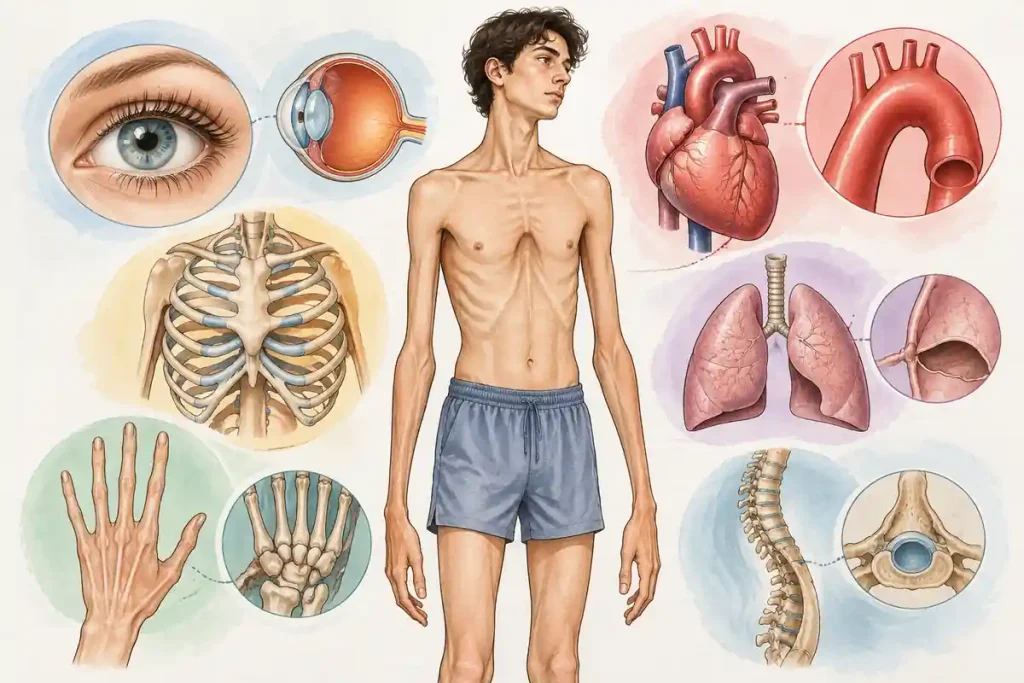
Marfan Syndrome at a Glance
| Topic | Key Information |
| Type | Genetic connective-tissue disorder |
| Main Gene | $FBN1$ |
| Inheritance | Autosomal dominant |
| Major Concern | Aortic dilation, aneurysm, and dissection |
| Other Major Systems | Eyes, skeletal system, lungs, skin |
| Diagnosis | Modified Ghent diagnostic criteria integrating clinical findings, systemic scores, family history, and genetic testing |
| Cure | No definitive cure; management focuses on risk reduction and symptom control |
| Treatment | Regular monitoring, medications (beta blockers or ARBs), and surgical repair when indicated |
| Exercise | Individualized; high-intensity competitive sports and heavy lifting are typically restricted |
| Pregnancy | Requires specialized pre-conception counseling and rigorous, frequent cardiovascular monitoring |
What Is Marfan Syndrome?
Marfan syndrome is a heritable condition that impacts connective tissue—the biological framework that supports bones, muscles, blood vessels, organs, and tendons. Connective tissue is rich in proteins, one of the most vital being fibrillin-1, which provides strength and elasticity to tissues.
Because connective tissue is ubiquitous, Marfan syndrome can affect multiple organ systems simultaneously. However, the presentation varies dramatically from person to person. Some individuals experience very mild symptoms that may go unnoticed for years, while others develop significant skeletal, ocular, or cardiovascular complications early in life.
It is important to note that having certain physical traits, such as being tall and thin, does not mean someone has Marfan syndrome. The diagnosis requires meeting specific clinical, genetic, or familial criteria rather than relying on appearance alone.
What Causes Marfan Syndrome?
$FBN1$ Gene
Marfan syndrome is caused by pathogenic variants (mutations) in the $FBN1$ gene located on chromosome 15. This gene contains the instructions for producing fibrillin-1, a major building block of microfibrils. Microfibrils provide structural support to connective tissues and regulate the availability of growth factors (such as TGF-beta) in the body. When $FBN1$ is altered, tissues lose their normal elasticity and strength, and excess growth factor signaling can lead to progressive weakness in the aorta and overgrowth of long bones.
Is Marfan Syndrome Hereditary?
Yes, Marfan syndrome follows an autosomal dominant pattern of inheritance. This means a single copy of the altered gene in each cell is sufficient to cause the disorder.
- Inherited from a parent: Approximately 75% of individuals with Marfan syndrome inherit the condition from an affected parent. An affected parent has a 50% chance of passing the $FBN1$ variant to each child.
- De novo (new) variants: Approximately 25% of cases result from a brand-new, spontaneous genetic variant occurring in individuals with no family history of the condition.
Signs and Symptoms of Marfan Syndrome
The signs of Marfan syndrome can manifest across several bodily systems. Because features develop over time, a person may show few signs in childhood and more distinct features during adolescence or adulthood.
Skeletal Symptoms
Changes to bone growth and joint structure are among the most recognizable features of Marfan syndrome:
- Tall, slender body habitus with disproportionately long arms, legs, fingers, and toes (arachnodactyly).
- Chest-wall deformities, such as a chest that sinks inward (pectus excavatum) or pushes outward (pectus carinatum).
- Scoliosis (curvature of the spine) or thoracolumbar kyphosis.
- Flat feet (pes planus) and flexible joints (joint laxity).
- Facial features including a long, narrow face, high-arched palate, and crowded teeth.
- Dural ectasia, a widening or ballooning ofomatous dural sac surrounding the spinal cord, which can cause lower back, leg, or abdominal discomfort.
Eye Symptoms
Ocular complications are common and can affect vision:
- Ectopia lentis (lens dislocation), where the lens of the eye shifts out of its normal position due to weakness in the suspensory ligaments (zonules).
- Severe nearsightedness (myopia).
- Increased risk for early cataracts, glaucoma, and retinal detachment.
Heart and Blood-Vessel Symptoms
Cardiovascular manifestations represent the most serious aspect of Marfan syndrome:
- Aortic-root dilation (measured and standardized via Z-scores), where the base of the aorta stretches.
- Aortic aneurysm (abnormal bulging) and the risk of aortic dissection (a tear in the inner layer of the aortic wall).
- Mitral valve prolapse or mitral regurgitation, which can cause heart murmurs, palpitations, or fatigue.
- Cardiovascular changes can remain entirely silent for years, producing no outward symptoms until significant dilation or an acute emergency occurs.
Lung Symptoms
- Pneumothorax (collapsed lung) due to the presence of small air-containing spaces (blebs) in the lungs.
- Restrictive lung disease patterns associated with severe chest wall or spinal deformities.
Skin and Other Symptoms
- Unexplained stretch marks (striae) on the skin not related to weight change or pregnancy.
- Increased susceptibility to hernias (inguinal or abdominal).
Marfan Syndrome in Children
Identifying Marfan syndrome in childhood can be challenging because many classic skeletal features become more pronounced during the adolescent growth spurt. However, early signs such as unexplained lens dislocation, extreme joint flexibility, family history, or rapid disproportionate linear growth can prompt pediatric evaluation.
Evaluating a child suspected of having Marfan syndrome typically involves pediatric cardiology (echocardiogram to check the aorta and calculate Z-scores), pediatric ophthalmology, and genetic counseling. Early identification allows pediatric specialists to monitor growth, establish activity guidelines, and implement protective medical therapies before serious complications arise.
How Is Marfan Syndrome Diagnosed?
There is no single blood test that can definitively diagnose Marfan syndrome. Instead, clinicians utilize the modified Ghent criteria, which establish specific diagnostic pathways depending on whether there is a family history of the condition.
Modified Ghent Diagnostic Pathways
The presence or absence of family history changes how clinical features combine to confirm a diagnosis:
| Scenario | Key Diagnostic Combinations (Modified Ghent Criteria) |
| Without Family History | • Ectopia lentis AND aortic-root dilation/dissection • Aortic-root dilation/dissection AND an identifying $FBN1$ pathogenic variant • Aortic-root dilation/dissection AND a systemic score $\ge 7$ points (after excluding alternative conditions) |
| With Family History | • Ectopia lentis AND a family history of Marfan syndrome • A systemic score $\ge 7$ points AND family history • Aortic-root dilation/dissection AND family history |
Evaluation Components
- Clinical Examination: Assessing body proportions, skin striae, and skeletal features.
- Echocardiogram: Measuring aortic-root dimensions (standardized by age and body size using Z-scores) and assessing heart valves.
- Comprehensive Eye Examination: Slit-lamp evaluation by an ophthalmologist.
- Genetic Testing: Sequencing the $FBN1$ gene. A negative $FBN1$ test does not completely rule out Marfan syndrome because diagnosis can be established clinically, and genetic testing does not identify every rare or novel pathogenic variant.
- Imaging (CT or MRI): Used when detailed visualization of the entire aorta or spinal canal is required.
Marfan Syndrome Systemic Score
The systemic score evaluates physical features associated with Marfan syndrome to assign points within the diagnostic framework. It is a formal clinical tool rather than a self-assessment checklist. Official components and point values include:
- Wrist AND thumb signs: 3 points (or 1 point if only one of the two signs is present).
- Pectus carinatum deformity: 2 points (or pectus excavatum/asymmetry = 1 point).
- Hindfoot deformity: 2 points (or plain flat foot/pes planus = 1 point).
- Pneumothorax: 2 points.
- Dural ectasia: 2 points.
- Protrusio acetabuli: 2 points.
- Reduced elbow extension ($\le$ 170 degrees): 1 point.
- Facial features (dolichocephaly, malar hypoplasia, retrognathia): 1 point.
- Skin striae (unexplained): 1 point.
- Myopia ($>$ -3 diopters): 1 point.
- Mitral valve prolapse: 1 point.
- Arm span-to-height ratio $\ge$ 1.05 or upper-to-lower segment ratio disproportion: 1 point.
Marfan Syndrome Treatment
While there is no cure for Marfan syndrome, modern medical management, lifestyle modifications, regular surveillance, and surgical interventions have successfully transformed outcomes for affected individuals.
Medicines
- Beta Blockers: Commonly prescribed to slow the heart rate and reduce the force of contractions, lowering hemodynamic stress on the aortic wall.
- Angiotensin Receptor Blockers (ARBs): Medications like losartan that help protect the aortic wall by modifying cellular signaling pathways related to connective tissue growth.
- Current clinical guidelines support the use of either beta blockers or ARBs (or combination therapy in appropriate patients) at maximally tolerated doses to slow the rate of aortic root growth.
Aortic Surgery
When aortic-root dilation reaches specific thresholds—or if the rate of growth is rapid—elective aortic-root replacement surgery may be recommended. Surgical timing is determined by a multidisciplinary team weighing absolute aortic diameter, body size, age, family history of dissection, growth rate, and the specific genetic variant involved.
Specialized Care
- Eye Care: Corrective lenses, routine ophthalmologic monitoring, and surgical management for cataracts, glaucoma, or lens dislocation.
- Orthopedic Care: Physical therapy, bracing for scoliosis, or surgical intervention for severe spinal or chest-wall deformities.
Exercise and Physical Activity
Exercise recommendations for individuals with Marfan syndrome must be strictly individualized based on cardiovascular status, aortic diameter, and overall risk profile.
- Generally Considered Appropriate (After Medical Assessment): Moderate aerobic activities, such as brisk walking or light, non-competitive swimming, provided they are cleared by a cardiologist.
- Typically Restricted or Avoided: Heavy weightlifting, intense isometric exercise, high-intensity competitive sports, contact sports, and activities involving significant physical straining or risk of sudden blunt chest impact.
How Often Should Marfan Syndrome Be Monitored?
Routine surveillance is critical for tracking stability and detecting changes early:
- Heart and Aorta: Following diagnosis, echocardiography is performed to establish baseline aortic dimensions and, commonly, repeated after about 6 months to assess the rate of aortic enlargement. If the aorta is stable, ongoing surveillance is generally performed at least annually, with more frequent imaging scheduled when individual risk factors or rapid growth rates are present.
- Eyes: Comprehensive ophthalmological examinations performed at least annually or as clinically indicated.
- Skeleton: Periodic clinical evaluations for scoliosis progression and joint stability during growth years.
Marfan Syndrome and Pregnancy
Pregnancy places increased hemodynamic demands on the maternal cardiovascular system, raising the workload on the heart and the pressure on the aorta.
- Pre-conception Counseling: Essential for evaluating baseline aortic size and discussing potential maternal risks with a cardiologist and maternal-fetal medicine specialist.
- Monitoring During Pregnancy: Rigorous cardiovascular surveillance is required. GeneReviews recommends echocardiographic monitoring every 2 to 3 months throughout pregnancy and into the postpartum period, depending on individual baseline aortic diameter and risk factors.
- Medication Management: Certain medical therapies used for aortic protection require careful evaluation during pregnancy due to potential fetal contraindications.
Possible Complications
- Cardiovascular: Aortic aneurysm, acute aortic dissection, aortic rupture, severe mitral regurgitation, and heart failure.
- Ocular: Lens dislocation, retinal detachment, glaucoma, and early cataracts.
- Musculoskeletal: Progressive scoliosis, chronic joint pain, and chest wall discomfort.
- Pulmonary: Spontaneous pneumothorax.
- Neurological: Dural ectasia causing chronic lower back or leg symptoms.
Emergency Warning Signs
Seek immediate emergency medical attention for sudden onset of:
- Severe, sharp, or tearing chest pain
- Severe upper-back pain between the shoulder blades
- Sudden shortness of breath
- Fainting or loss of consciousness
- Sudden neurological changes, weakness, or numbness
- Sudden, severe vision loss or major visual disturbances
Acute aortic dissection and retinal detachment are medical emergencies requiring immediate intervention.
Life Expectancy and Outlook
With early diagnosis, proactive cardiovascular monitoring, appropriate medical therapy, and timely surgical intervention, individuals with Marfan syndrome can lead full, active lives. Modern clinical management has successfully shifted life expectancy so that it closely approximates that of the general population.
Family Screening and Genetic Counseling
When one family member is diagnosed with Marfan syndrome, first-degree relatives (parents, siblings, children) should undergo professional clinical evaluation. If the familial $FBN1$ pathogenic variant is known, targeted genetic testing can clarify which family members carry the variant and require ongoing monitoring, and which do not. Genetic counseling helps families navigate inheritance patterns, reproductive options, and psychological support.
Frequently Asked Questions
Is Marfan syndrome genetic?
Yes, Marfan syndrome is a genetic disorder caused by alterations in the $FBN1$ gene and is inherited in an autosomal dominant pattern.
What gene causes Marfan syndrome?
Pathogenic variants in the $FBN1$ gene, which encodes the protein fibrillin-1, cause Marfan syndrome.
Can Marfan syndrome be cured?
There is currently no cure for Marfan syndrome, but complications can be effectively managed through regular monitoring, medications, and surgical interventions.
Can a person have Marfan syndrome without being very tall?
Yes. While tall stature is common, physical features vary widely, and some individuals with Marfan syndrome do not present with extreme height.
Does Marfan syndrome affect the heart?
Yes, it frequently affects the cardiovascular system, most notably by causing stretching of the aorta and potential mitral valve issues.
Can Marfan syndrome cause aortic aneurysm?
Yes, connective tissue weakness can cause the aortic root to widen, forming an aneurysm that requires close monitoring and potential surgical repair.
Can people with Marfan syndrome exercise?
Many individuals can engage in moderate aerobic activity after an individualized medical assessment, but high-intensity sports, heavy weightlifting, and contact sports are generally restricted.
Can someone with Marfan syndrome live a normal life?
With proper medical care, early diagnosis, and adherence to activity and monitoring guidelines, life expectancy with proper management can approximate that of the general population.
What tests diagnose Marfan syndrome?
Diagnosis is based on the modified Ghent criteria, which incorporates a physical examination, family history, echocardiography, eye evaluations, and genetic testing.
Can women with Marfan syndrome become pregnant?
Yes, but pregnancy requires specialized pre-conception counseling and close cardiovascular monitoring (such as echocardiograms every 2 to 3 months) due to increased demands on the aorta.
Key Takeaways
- Marfan syndrome is a heritable connective-tissue disorder driven primarily by variants in the $FBN1$ gene.
- Regular cardiovascular monitoring—specifically tracking aortic dimensions using standardized Z-scores and individualized intervals—is the cornerstone of preventing life-threatening complications.
- Treatment combines specialized medical therapy (such as beta blockers or ARBs), tailored activity modifications, and timely surgical intervention when necessary.
- Comprehensive multidisciplinary care and genetic counseling significantly improve long-term health outcomes and overall life expectancy.