
Why Do Your Feet Swell After Sitting or Standing All Day?
You catch a glimpse of your ankles at the end of a long workday, and your socks have left deep, angry indentations into your skin. Your shoes feel tight. Your feet look a little pillowy, maybe even heavy and achy. If you spent the last eight hours chained to an office chair or standing behind a retail counter, this kind of mild, late-day swelling feels almost routine.
Gravity is the obvious suspect, but gravity alone doesn’t entirely explain why fluid pools in your lower extremities by 6:00 PM.
Understanding what is actually happening beneath the skin requires looking at how fluid circulates through the human body, why stillness is the enemy of circulation, and what separates a harmless daily annoyance from something that warrants a conversation with a physician.
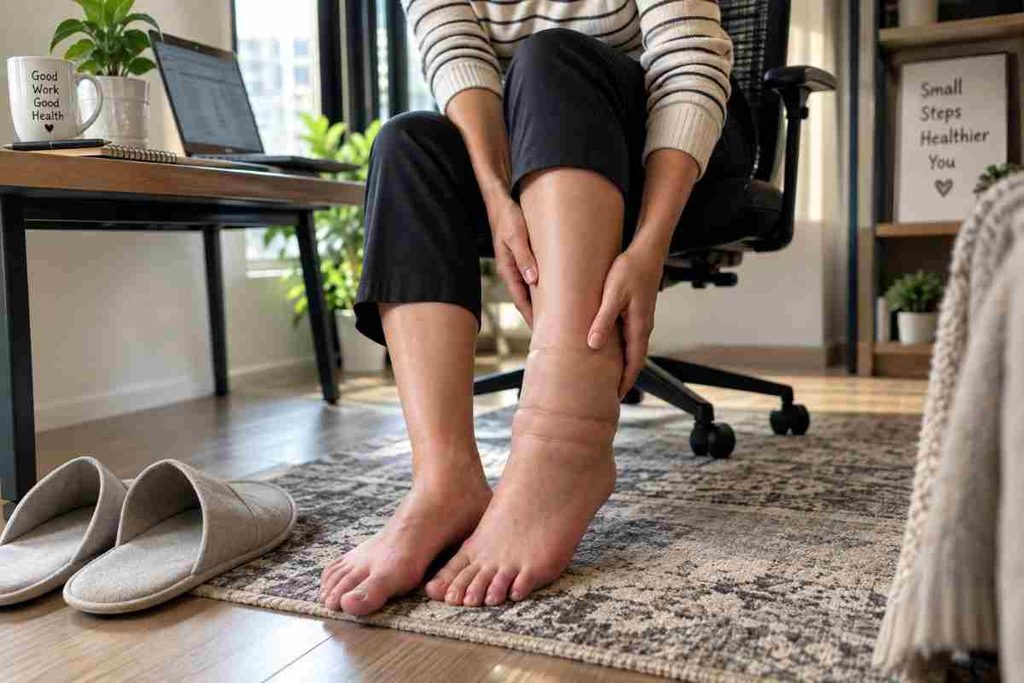
Table of Contents
The Mechanics of Lower-Body Fluid Retention
To understand why feet swell after hours of static posture, it helps to look at how blood travels back up to the heart. When your heart pumps, oxygenated blood travels down into your legs through arteries. But getting that blood back up against the pull of gravity requires a completely different mechanism.
Your veins rely heavily on the contraction of surrounding skeletal muscles—particularly the calf muscles—to act as a natural pump. Every time you take a step, those muscles squeeze the deep veins in your legs, pushing blood upward. Inside those veins, one-way valves snap shut behind the blood to keep it from sliding backward.
When you sit or stand still for hours, that calf-muscle pump essentially goes to sleep.
Without muscular contraction to assist them, your veins have to work overtime against gravity. Blood pressure inside the small blood vessels (capillaries) in your lower legs increases. This pressure forces a small amount of fluid out of the blood vessels and into the surrounding interstitial spaces—the tiny gaps between your tissues.
Add in the natural effect of gravity pulling fluid downward all day, and that fluid accumulates in the lowest points of your body: your ankles and feet. Medical professionals call this dependent edema. It is essentially localized fluid pooling caused by posture and gravity.
Sitting Versus Standing: Two Different Roads to the Same Swelling
Though both sitting and standing result in puffy ankles by evening, they stress the circulatory system in distinct ways.
When you sit all day, your hip and knee joints remain bent at roughly a 90-degree angle for hours. This constant flexion places physical pressure on the major blood vessels in your pelvis and thighs, partially impeding the smooth return of blood from your lower legs back toward your heart. Furthermore, sitting requires zero muscular effort from your lower body, meaning your calf pump is completely inactive.
Standing presents a different problem. While your muscles are technically engaged in postural control, they aren’t contracting dynamically enough to pump blood efficiently. Instead, you are subjecting your lower-leg veins to a continuous, unbroken column of hydrostatic pressure. Over a long shift on your feet, the walls of your veins and capillaries can become slightly more permeable, allowing more fluid to slip out into the surrounding tissue.
Dietary and Lifestyle Amplifiers
Gravity and posture set the stage, but daily habits can dramatically amplify the swelling.
Sodium intake is a major player. The kidneys tightly regulate the balance of sodium and water in your body. If you consume a meal heavy in sodium—common in restaurant food or packaged convenience items—your body holds onto extra water to maintain proper electrolyte concentrations. That extra fluid expands your total blood volume, increasing pressure inside your capillaries and making it much easier for fluid to leak into your feet when you’re sedentary.
Hydration plays a counterintuitive role, too. It seems logical that if your feet are retaining water, you should drink less of it. In reality, chronic mild dehydration signals the body to hoard whatever fluids it has, which can actually worsen fluid retention.
Hormonal shifts also matter. Natural fluctuations in estrogen and progesterone—whether due to the menstrual cycle, pregnancy, or hormone replacement therapy—cause blood vessels to relax and become more permeable, predisposing some people to noticeable fluid pooling after a long day of standing.
What is Normal, and What Is a Red Flag?
For the vast majority of people, end-of-day foot swelling is a benign, mechanical response to a sedentary job or a long-distance flight. It typically appears symmetrically in both feet, develops gradually as the day wears on, and vanishes by morning after a night of lying flat.
However, swelling is also a symptom of several underlying medical conditions that require proper diagnosis. You need to look at the pattern.
If the swelling affects only one foot or one leg rather than both, or if it is accompanied by pain, redness, warmth, or tenderness in the calf, you should treat it as a medical priority. These can be warning signs of a deep vein thrombosis (DVT), a blood clot in a deep vein that requires immediate medical evaluation.
Similarly, swelling that does not go away overnight, or swelling that creeps up into your thighs, abdomen, or hands, points away from simple postural edema. Persistent, generalized fluid retention can be an indicator of chronic venous insufficiency, kidney dysfunction, liver disease, or congestive heart failure.
Practical Strategies to Manage Daily Swelling
If your evening foot swelling is purely mechanical and linked to your daily routine, you can disrupt the cycle with a few targeted adjustments. You don’t need expensive gadgets; you just need to work with your body’s physiology.
- Move the calf pump: If you sit at a desk, make a habit of flexing your ankles, pointing your toes, or standing up to pace for two minutes every hour. If you stand for work, shift your weight frequently and perform seated heel-raises whenever possible.
- Elevate strategically: At the end of the day, lie down and prop your feet up on pillows so they rest above the level of your heart for 20 to 30 minutes. This lets gravity help drain the accumulated interstitial fluid back into general circulation.
- Consider compression: Graduated compression socks apply gentle, consistent pressure to the lower leg, narrowing the superficial veins and helping push blood upward toward the heart before it can pool in the ankles.
- Evaluate your sodium habits: Pay attention to how heavy sodium intake correlates with your worst swelling days. Reducing highly processed foods can noticeably change how much fluid your lower legs retain by evening.
End-of-day swelling is mostly your body’s way of telling you that human biology wasn’t engineered for eight straight hours of unmoving chairs or concrete floors. But because persistent swelling can occasionally mask deeper circulatory issues, pay attention to your body’s patterns. If the puffiness becomes your new normal or arrives with pain and asymmetry, it is time to stop guessing and consult a healthcare professional.