Why Is My Hair Thinning on One Side? Causes & Treatment
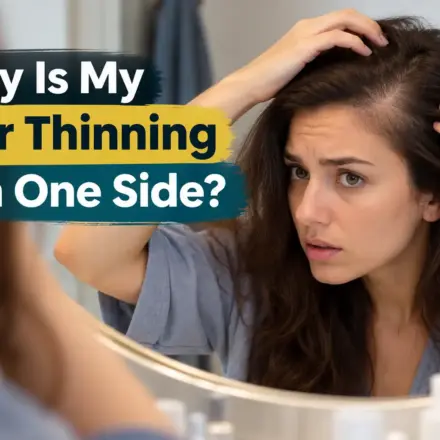
Noticing hair thinning on one side of the head is surprisingly common, but it can be unsettling. In many cases, it comes down to natural anatomical asymmetry, hair growth direction, or styling habits. In others, it indicates an underlying medical form of hair loss—such as traction alopecia, alopecia areata, early androgenetic alopecia, or a scalp infection.
Because treatments that resolve one type of thinning can be ineffective or even counterproductive for another, figuring out what is actually causing the uneven density is the essential first step.

Hair thinning on one side often stems from styling habits, a natural hair part, or uneven breakage. However, localized medical conditions like traction alopecia, early pattern hair loss, fungal infections, or alopecia areata can also cause true one-sided shedding. Mild asymmetry is normal, but visible scalp patches, itching, pain, or widening recession should be evaluated by a board-certified dermatologist.
Is Hair Thinning on One Side Normal?
The human body is naturally asymmetrical, and the scalp is no exception. Before exploring medical conditions, it helps to separate visual asymmetry from true hair loss.
Natural Differences in Follicle Density and Direction
Hair follicles do not grow in identical grids across both hemispheres of the scalp. One side may naturally host slightly fewer follicles per square centimeter, or the hairs may grow at a flatter angle against the skin, exposing more scalp under overhead bathroom lighting.
Hair Parting and Scalp Visibility
Where you part your hair plays a massive role in perceived volume. When hair is parted to the left, the left side lays flatter while the right side carries the bulk of the hair flipped over it. Over months or years, this constant directional split can make the parted side look thinner simply because it lacks the layered density of the opposite side.
Visual Illusion vs. Progressive Loss
- Visual Asymmetry: The hair looks slightly thinner in certain lights or parting styles, but the scalp skin is healthy, no excessive shedding occurs in the shower, and the difference remains stable year after year.
- Progressive Thinning: You notice a measurable shift: the ponytail diameter shrinks, one temple recedes further month over month, hair shafts break off short, or bare patches appear.
If you are tracking overall wellness and hair vitality, learning more about daily routines through Healthfity’s lifestyle guides can help you identify subtle daily habits contributing to hair strain.
What Causes Hair Thinning on One Side of the Head?
When actual follicle loss or shaft degradation is underway, the causes generally fall into two categories: mechanical factors that physically damage the hair, and underlying medical conditions that affect the follicles directly. Several distinct dermatological and mechanical conditions may be responsible.
1. Traction Alopecia
Traction alopecia develops when continuous pulling forces strain hair follicles, eventually causing inflammation and loosening the hair shaft. This frequently presents asymmetrically:
- Parting hair on the same side and pulling it into a tight ponytail or bun.
- Braids, cornrows, or weaves that are secured tighter along one temple or ear.
- Wearing hair extensions anchored primarily on one section.
According to clinical criteria outlined by the American Academy of Dermatology (AAD), early traction alopecia is reversible if physical tension is stopped promptly. Continued pulling over years, however, can cause permanent follicular scarring.
2. Alopecia Areata
Alopecia areata is an autoimmune disorder where the immune system mistakenly targets hair follicles, arresting hair production. It classically appears as one or more smooth, round, coin-sized bald spots. If the initial focal patch develops near the right ear or left crown, the hair loss presents strictly on that side. The underlying skin typically looks smooth and non-scarred.
3. Early Androgenetic Alopecia (Pattern Hair Loss)
Androgenetic alopecia—commonly referred to as male or female pattern baldness—is driven by genetic sensitivity to dihydrotestosterone (DHT), which triggers gradual hair follicle miniaturization. While pattern baldness eventually follows a symmetric distribution (temple recession or crown widening), it frequently starts unevenly. One temple or side of the crown often recedes or thins several months ahead of the other.
4. Hair Breakage and Mechanical Damage
Sometimes the follicle is completely healthy, but the hair shaft snaps before reaching full length. Uneven breakage often happens when:
- High-heat styling tools (flat irons, curling wands) are used more aggressively on the dominant-hand side.
- Chemical treatments (bleach, relaxers, perm solutions) overlap unevenly.
- Shoulder bags or backpack straps regularly catch and tear strands on one shoulder.
For those focusing on whole-body wellness to protect hair integrity, reviewing Healthfity’s nutrition section can help ensure your diet provides the protein and micronutrients required for hair shaft strength.
5. Tinea Capitis (Scalp Fungal Infection)
More prevalent in children but fully possible in adults, tinea capitis is a dermatophyte infection of the scalp. It tends to form discrete, spreading patches of hair thinning or loss on whichever side the fungus colonized. Distinctive signs include flaky scaling, redness, and “black dots,” which are brittle hair shafts broken flush at the scalp surface.
6. Trichotillomania
Trichotillomania is a recognized impulse-control condition characterized by the recurrent urge to pull out one’s own hair. Because most people have a dominant hand, pulling is frequently focused on one side of the scalp—often the fronto-temporal or parietal region—resulting in an uneven, irregular patch of broken, blunt hairs of varying lengths.
7. Temporal Triangular Alopecia
Also known as congenital triangular alopecia, this is a non-scarring, non-inflammatory condition where a triangular or lancet-shaped patch of fine vellus hair appears near the frontotemporal scalp. While often present since early childhood, it may only become cosmetically apparent in adulthood as surrounding hair changes in texture or length. It is overwhelmingly unilateral (occurring on one side).
8. Scarring (Cicatricial) Alopecia
Conditions such as Lichen Planopilaris (LPP) or Frontal Fibrosing Alopecia (FFA) involve inflammatory cellular attacks that destroy the follicle stem cells, replacing them with fibrous scar tissue. While FFA classically affects the frontal hairline, it can begin asymmetrically. Warning signs include localized scalp tenderness, burning, redness around the follicle base (perifollicular erythema), and an absence of visible follicular openings. The National Organization for Rare Disorders (NORD) emphasizes that early medical intervention is crucial to arrest active scarring before follicles are permanently lost.
Causes at a Glance: Clues and Next Steps
| Suspected Cause | Typical Visual Clues | Associated Scalp Symptoms | Initial Diagnostic Approach |
| Traction Alopecia | Thinning along hairline or parted border; broken fringe hairs | Scalp tenderness, bumpiness (folliculitis) after styling | Styling history review; dermoscopy checking for hair casts |
| Alopecia Areata | Well-defined, smooth, coin-shaped patch | Minimal; occasional mild tingling or itching | Trichoscopy checking for “exclamation point” hairs |
| Pattern Hair Loss | Uneven temple recession or asymmetric widening of the part | None; painless and non-itchy | Assessment of miniaturization via dermoscopy |
| Hair Breakage | Uneven length; frayed ends; thinning ends with normal roots | Normal scalp; no follicle loss | Hair shaft pull test and microscopic examination |
| Tinea Capitis | Circular thinning with scaling; “black dot” stubs | Itching, scaling, redness; tender lymph nodes | Fungal culture or KOH preparation mount |
| Cicatricial Alopecia | Smooth, shiny patches lacking follicular pores | Burning, itching, pinpoint redness | Immediate scalp punch biopsy |
Note: Physical symptoms overlap considerably across different forms of alopecia. A physical exam by a dermatologist is necessary to confirm a diagnosis.
Hair Thinning on One Side: Differences in Women and Men
While biological mechanisms share common ground, presentation frequently diverges based on styling norms, genetics, and hormones.
In Women
Women experiencing one-sided thinning frequently contend with traction forces, telogen shifts, or female pattern hair loss:
- Styling Tension: Deep side-parts, heavy clip-in extensions, and rigid ponytails place high mechanical torque on a single hemisphere of the scalp.
- Female Pattern Hair Loss (FPHL): Unlike men, women generally retain their frontal hairline, experiencing diffuse thinning over the mid-frontal scalp and crown. However, this often starts with the central part widening unevenly toward the dominant side.
- Hormonal Fluctuations: Shifts during postpartum periods or perimenopause can trigger widespread shedding. While this diffuse shedding (telogen effluvium) affects the whole scalp, underlying natural asymmetry often makes one side look significantly worse.
To explore systemic causes of hair changes, read through Healthfity’s general health articles for insights into endocrine and metabolic health.
In Men
In men, unilateral thinning most frequently traces back to:
- Asymmetric Male Pattern Hair Loss: Men prone to androgenetic alopecia rarely recede with mathematical symmetry. The left or right temporal peak often creeps backward first before the other catches up.
- Beard or Sideburn Extension: Alopecia areata can occur simultaneously across one temple and the adjacent beard line on the same side.
Does Sleeping on One Side Cause Hair Loss?
A widespread myth suggests that sleeping primarily on your right or left side cuts off blood circulation to those hair follicles, causing them to wither and fall out.
Medical evidence does not support this claim. Scalp blood flow is robust, supplied by extensive branching networks derived from both the internal and external carotid arteries. Normal resting pressure on a pillow is nowhere near sufficient to cause ischemic follicle death.
However, side sleeping can play a minor mechanical role:
- Surface Friction: Coarse cotton pillowcases combined with restless head movements can generate friction, worsening hair breakage if your hair is already brittle, chemically processed, or fine.
- Tangled Knots: Friction can lead to localized knotting, causing you to pull strands out forcefully during morning brushing.
If you sleep exclusively on one side and notice shorter, frizzy, broken hairs there, friction-related shaft breakage—not follicle death—is the likely culprit. Switching to a smooth silk or satin pillowcase and addressing hair hydration often mitigates this issue.
How Dermatologists Diagnose One-Sided Thinning
Because guessing the cause can lead to ineffective interventions, dermatological evaluation follows a systematic clinical process involving physical assessment, magnified examination, and targeted laboratory testing.
1. Clinical History and Scalp Examination
Your physician will evaluate your timeline: Did the thinning appear over two weeks or two years? They will review family history, styling practices, medications, nutritional habits, and stress events. They will also inspect the scalp to check for signs of inflammation, redness, or pustules.
2. The Hair Pull Test
The dermatologist gently grasps a cluster of roughly 40 to 60 hairs between their thumb and index finger and exerts slow, light traction away from the scalp. If more than 10% of the grasped hairs release easily without pain, it points to active telogen shedding or inflammatory activity.
3. Trichoscopy (Dermoscopy)
Using a specialized high-magnification dermatoscope, the clinician inspects the scalp surface and hair shafts up close:
- Miniaturization: Variable hair shaft diameters in the same region indicate androgenetic alopecia.
- Exclamation Point Hairs: Short hairs that are narrow at the base and dark at the tip strongly suggest active alopecia areata.
- Follicular Openings: Missing follicular ostia point toward scarring processes.
4. Lab Tests and Scalp Biopsy
When an underlying systemic issue or scarring alopecia is suspected, dermatologists may order:
- Blood Panels: Testing for ferritin (iron storage), thyroid-stimulating hormone (TSH), vitamin D, and specific androgens via guidelines from the Endocrine Society.
- Scalp Punch Biopsy: Removing a small 4mm core of scalp tissue under local anesthesia allows a pathologist to evaluate follicle structure, immune cell infiltration, and the presence of scarring under a microscope.
For those tracking complementary diagnostics, Healthfity’s skin care resources provide additional background on how clinical dermatological exams are structured.
Treatment Options Based on Cause
Effective treatment depends entirely on identifying the correct underlying mechanism. Using a stimulating hair oil will not resolve an autoimmune attack, nor will anti-dandruff shampoo fix tension from tight braids.
Addressing Traction Alopecia
- Action: Immediately eliminate high-tension hairstyles. Loosen braids, opt for soft scrunchies, and alternate your hair part regularly.
- Clinical Care: If the scalp shows inflammation or folliculitis bumps along the tension border, dermatologists may prescribe topical or intralesional corticosteroids, or topical antibiotics.
Treating Alopecia Areata
- Intralesional Corticosteroids: The National Institutes of Health (NIH) documents that localized superficial steroid injections (triamcinolone acetonide) into bald patches are a primary first-line intervention to calm immune activity and prompt regrowth.
- Systemic Options: For rapidly spreading or widespread patches, newer oral therapies such as JAK inhibitors (e.g., baricitinib, ritlecitinib) are approved by the U.S. Food and Drug Administration (FDA) for severe alopecia areata.
Treating Pattern Hair Loss (Androgenetic)
- Topical Minoxidil: An over-the-counter medication approved by the FDA for both men and women. Minoxidil works as a potassium channel opener that prolongs the anagen (growth) phase of follicles and enhances blood supply.
- Oral Anti-Androgens: For men, oral finasteride or dutasteride inhibits the 5-alpha-reductase enzyme, reducing DHT production. For select female patients, spironolactone or low-dose oral minoxidil may be prescribed under strict medical guidance.
- Adjunctive Therapies: Low-level laser therapy (LLLT) and platelet-rich plasma (PRP) injections have supportive clinical data showing improvements in hair density when paired with primary medical therapies.
Managing Fungal Infections and Scalp Disorders
- Antifungal Regimens: Fungal infections within hair follicles cannot be cleared with topical creams alone. Oral antifungals such as griseofulvin or terbinafine, taken for 4 to 8 weeks, are standard medical protocols. Medicated ketoconazole shampoos are frequently added to reduce spore shedding.
- Anti-Inflammatory Protocols: Scalp conditions like seborrheic dermatitis or psoriasis require prescription topical calcineurin inhibitors, zinc pyrithione, or topical corticosteroids to alleviate the inflammation driving secondary shedding.
When making lifestyle adjustments to support recovery, pairing medical plans with balanced nutrition can assist hair regeneration. Explore Healthfity’s fitness guides to learn how physical activity improves peripheral circulation and stress resilience.
Can Hair Thinning on One Side Grow Back?
Whether hair regrows depends primarily on one factor: the survival of the hair follicle stem cells.
- High Reversibility: Thinning caused by mild traction, acute telogen effluvium, breakage, or successfully treated fungal infections generally regrows once the stressor or pathogen is removed. Full visual recovery can take 6 to 12 months due to the natural hair growth cycle (growing roughly half an inch per month).
- Manageable/Maintainable: Androgenetic alopecia cannot be “cured,” but consistent treatment can arrest progression, reverse miniaturization, and significantly thicken existing hairs.
- Permanent Loss: If inflammation has completely scarred over the follicle openings—as seen in late-stage traction alopecia or untreated lichen planopilaris—regrowth is not biologically possible. In these instances, treatment aims to preserve surrounding hair, and hair restoration surgery (transplantation) may be considered once active inflammation has ceased for over a year.
When to See a Dermatologist
Consult a physician or board-certified dermatologist promptly if you observe:
- Sudden expansion of bald patches over days or weeks.
- Accompanying scalp symptoms like persistent burning, throbbing pain, raw patches, or crusting.
- Visible loss of follicle pores, leaving the skin looking unusually shiny or ivory-white.
- Hair shedding accompanied by unexplained weight changes, profound fatigue, or joint pain.
To learn more about how everyday systemic wellness influences physical recovery, visit Healthfity’s wellness archive to explore the physiological connections between metabolic health, body weight, and cellular renewal.
Frequently Asked Questions
Why is my hair thinning on one side but not the other?
Unilateral thinning typically stems from asymmetrical habits—such as parting your hair consistently on one side, sleeping on a rough surface, or applying more tension during styling. It can also mark the early, asymmetrical onset of pattern hair loss or a localized skin condition such as alopecia areata or tinea capitis.
Can a dermatologist tell if my hair is thinning?
Yes. Using trichoscopy, a dermatologist can view individual follicles magnified up to 70 times. This allows them to detect early signs of miniaturization, inflammation around follicle roots, damaged hair shafts, and reduced hairs per follicular unit long before thinning is obvious to the naked eye.
What tests do dermatologists do for hair loss?
Dermatologists routinely perform a clinical scalp exam, a gentle hair pull test, and dermoscopy. When indicated, they may order comprehensive blood tests (evaluating ferritin, thyroid panels, and hormone levels) or perform a small 4mm punch biopsy of the scalp to inspect follicle architecture under a microscope.
What do dermatologists prescribe for thinning hair?
Prescriptions vary based on the diagnosis. Common options include topical or oral minoxidil, oral anti-androgens like finasteride or spironolactone for pattern baldness, intralesional steroid injections for alopecia areata, oral antifungals for tinea capitis, and topical or oral anti-inflammatories for scarring scalp conditions.
Can stress cause hair loss on only one side?
Stress-induced hair loss (telogen effluvium) typically causes diffuse, generalized shedding across the entire scalp, not isolated one-sided baldness. However, if you already have a preexisting, subtle asymmetry in hair density, diffuse shedding can make that naturally thinner side look substantially more noticeable.
Why is my hairline receding on only one side?
Uneven hairline recession is very common in early androgenetic alopecia, where follicles on one temple exhibit greater sensitivity to DHT or miniaturize faster than those on the opposite side. It can also stem from focal traction alopecia if braids, weaves, or tight headwear pull unevenly along that side of the forehead.