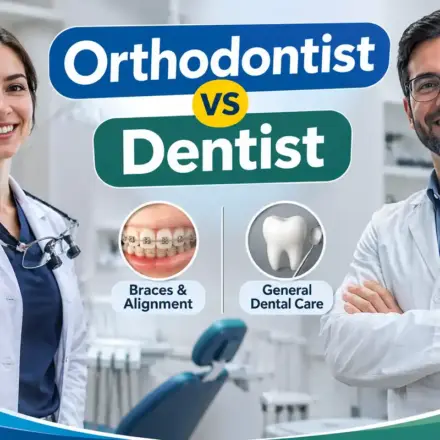
Orthodontist vs Dentist: Differences and When to See Each
Dentists and orthodontists both work on teeth, and both went to dental school. The difference is training and focus. A dentist looks after the health of your teeth and gums. An orthodontist is a dentist who went on to spend additional years studying how teeth and jaws grow, move, and fit together. Knowing which one to call first can save you a wasted appointment, or a referral you didn’t need.
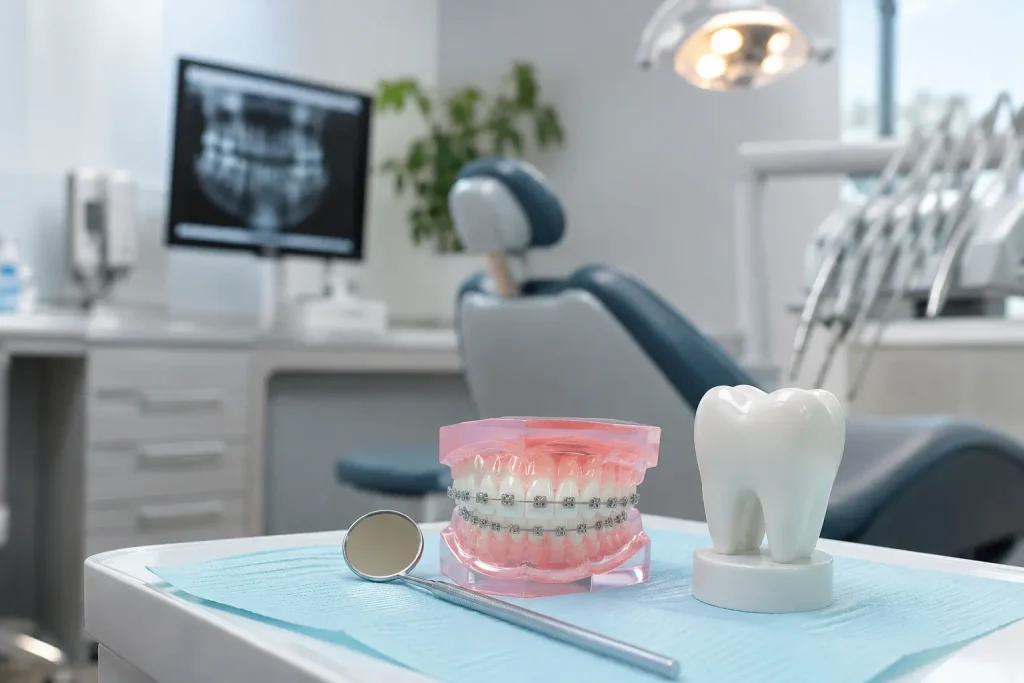
Every orthodontist is a dentist, but most dentists are not orthodontists. A general dentist handles checkups, cleanings, cavities, gum problems, toothaches, and broken teeth. An orthodontist handles crooked or crowded teeth, bite problems, jaw-growth concerns in children, and braces, aligners, and retainers. You can usually book an orthodontic consultation directly, and during treatment you will likely need both.
Training is the real dividing line
After dental school, a general dentist can practice without additional formal training, according to the Bureau of Labor Statistics. A dentist who wants to practice a specialty must complete a postdoctoral residency, usually two to four years. For orthodontics, the American Association of Orthodontists (AAO) puts that extra training at 24 to 36 months in an accredited program, focused on moving teeth and guiding jaw development.
Orthodontics is one of 12 dental specialties recognized through the ADA’s National Commission on Recognition of Dental Specialties. Specialists are a small group. The BLS counts roughly 141,900 general dentists in the US and about 7,100 orthodontists, so in smaller towns you may have to travel for an orthodontic appointment.
The AAO also notes that some states allow general dentists to provide specialty care without formal specialty training. A dentist who can place braces or aligners is not automatically an orthodontist, and a dentist who can do a root canal is not automatically an endodontist.
What a general dentist does
A general dentist is your home base for oral health. According to the BLS, a dentist’s usual work includes:
- removing decay and filling cavities
- repairing or removing damaged teeth
- placing sealants
- taking and reading X-rays
- teaching patients about diet, flossing, and fluoride
They also catch problems early, such as gum inflammation, suspicious spots, and worn enamel. If you only see one dental professional, it should be this one. The American Dental Association’s MouthHealthy site recommends brushing twice a day with fluoride toothpaste and cleaning between your teeth daily. Your dentist checks whether that routine is working.
What an orthodontist does
Orthodontists work on alignment and bite: how your teeth line up, how the upper and lower teeth meet, and how the jaws relate to each other. Their tools include braces, clear aligners, retainers, expanders, and other appliances.
The formal specialty name is “orthodontics and dentofacial orthopedics.” The orthopedics part refers to guiding jaw growth, mostly in children. It has nothing to do with bone and joint doctors, which is a common mix-up (more on that below).
The AAO lists several signs in a child that a bite may need a look:
- baby teeth lost unusually early or late
- trouble chewing or biting
- mouth breathing
- jaws that shift or make noise
- speech difficulties
- a lower face that looks noticeably uneven
Dentist vs orthodontist at a glance
| General dentist | Orthodontist | |
|---|---|---|
| Training after dental school | None required | Typically 2–3 years of full-time specialty training |
| Main focus | Health of teeth and gums | Alignment of teeth and jaws |
| Typical visits | Checkups, cleanings, fillings, extractions, crowns | Braces, aligners, expanders, retainers |
| Visit rhythm | Often about every six months, or as advised | Every few weeks during active treatment, then retainer checks |
| Referral needed? | No | Generally no, per the AAO |
Who should you see first?
For most problems the answer is clear. Here is a practical way to sort it out.
| Your situation | Start with |
|---|---|
| Toothache, sensitivity, a cavity, a chipped or cracked tooth | Dentist |
| Bleeding or swollen gums, bad breath that won’t go away | Dentist |
| Routine cleaning or checkup | Dentist |
| Crowded, crooked, or gapped teeth | Orthodontist |
| Overbite, underbite, crossbite, or teeth that don’t meet properly | Orthodontist |
| Wanting braces or aligners | Orthodontist |
| Broken or lost retainer, loose bracket | Orthodontist |
| Child with a bite concern, or approaching age 7 | Orthodontist (a dentist can also point out concerns) |
| Jaw pain, clicking, or headaches | Dentist first, since several causes are possible |
| Not sure | Either one. Both can point you to the right place |
Children are a special case. The AAO recommends a first orthodontic check-up when a problem is first noticed, and no later than age 7. That visit does not mean braces are coming. Many children are simply monitored as they grow, and the purpose is to decide whether treatment is needed now, later, or not at all. Parents don’t need to wait for a dentist to suggest it. The AAO says directly that no referral is required. If your dental plan has its own rules about specialists, check them before booking.
Adults are welcome too. The AAO notes that adults can benefit from orthodontic care at any age.
“My dentist offers braces. Is that the same thing?”
This is the question most articles skip, and it comes up often. Some general dentists offer braces or aligners. The title on the door tells you how they were trained, but not how careful they are, so the useful move is to ask. A few reasonable questions:
- Did you complete a full-time specialty program in orthodontics, or did you learn through courses?
- How often do you treat cases like mine?
- If treatment isn’t going as planned, who takes over?
- What records will you take before starting (exam, X-rays, scans)?
A good practice, whether general or specialist, answers these plainly and doesn’t rush you.
Mail-order aligners are a different matter. The AAO strongly discourages them. Many programs skip an in-person exam and X-rays, and without those the plan can’t account for what’s happening under the gums, such as tooth roots and jaw structure. Moving teeth changes the bone and tissue around them, so it works best with proper supervision.
You’ll probably need both
People often assume getting braces means “graduating” from the dentist. It doesn’t. Braces and aligners make cleaning harder, so the dentist’s job gets more important during treatment. The usual pattern looks like this:
- Before treatment: orthodontists generally want active cavities and gum problems dealt with first, which is a dentist’s job.
- During treatment: the orthodontist adjusts and monitors tooth movement, while your dentist keeps up regular cleanings and checks for decay. Standard guidance is to continue dental visits about every six months, or more often if advised.
- After treatment: the orthodontist manages retainers, and your dentist continues routine care.
If gum bleeding, new sensitivity, or a cavity appears mid-treatment, tell both offices. Our guide to gum disease symptoms and treatment covers what to watch for.
The “-dontist” lineup, decoded
Dental titles blur together. Here is how the common ones differ, using the BLS descriptions:
| Specialist | What they focus on |
|---|---|
| Orthodontist | Straightening teeth and aligning the bite with braces and other appliances |
| Periodontist | The gums and the bone that support the teeth |
| Endodontist | Root canal treatment for injured or infected teeth |
| Pediatric dentist | Dental care for children and patients with special needs |
| Oral and maxillofacial surgeon | Surgery of the mouth, jaws, and face, such as impacted teeth or cleft repair |
An orthopedist is a different profession altogether. According to the American Academy of Orthopaedic Surgeons, orthopaedics is the medical specialty for injuries and diseases of the musculoskeletal system: bones, joints, muscles, and nerves. Orthopedic surgeons are medical doctors, not dentists. If you hurt your knee, you want an orthopedist. If your teeth are crooked, you want an orthodontist.
What about cost?
Orthodontic treatment is typically a longer, separate course of care from routine dental work. Dental plans that include orthodontics often treat it as its own benefit, with its own limits and sometimes a waiting period. Coverage for adults can differ from coverage for children. The safest approach is to call your plan before the consultation and ask what orthodontic benefits exist, what the limits are, and whether any waiting period applies. Many orthodontic offices will also walk you through payment options at the first visit.
Choosing a good one
Whichever professional you pick, look for clear explanations, a diagnosis based on actual records rather than a guess, and a plan that fits your mouth instead of a package. The AAO suggests asking about membership in the association, since membership is limited to trained orthodontic specialists, and comparing more than one consultation if you want a second opinion.
FAQ
Should I see a dentist or an orthodontist first?
It depends on the problem. For pain, cavities, gum trouble, or a checkup, start with a dentist. For crooked teeth, bite concerns, or braces and aligners, an orthodontist is the better first stop, and the AAO says you don’t need a referral. If you’re unsure, a general dentist can look at the whole picture and point you to the right place. Our guide on how to choose a dentist can help.
Can a dentist put on braces?
In many states, yes. A licensed general dentist may be allowed to offer braces or aligners. That doesn’t make them an orthodontist, who has completed accredited specialty training on top of dental school. Ask about their training and experience, and see our comparison of braces vs clear aligners to understand your options.
What is the 2-2-2 rule for teeth?
It’s a popular shorthand rather than an official clinical rule: brush twice a day, for two minutes, and see the dentist twice a year. It lines up with the ADA’s brushing advice on MouthHealthy. How often you need checkups can vary, so your dentist may suggest a different schedule.
What is the 3-3-3 rule for teeth?
There’s no single official version. Different dental blogs use it for different things, such as brushing routines or timing around a toothache. Because the versions don’t agree, treat it as a memory aid rather than medical guidance. Persistent tooth pain should be checked by a dentist rather than managed on a schedule at home. See our guide to toothache causes and when to get help.
What’s the difference between an orthodontist and an orthopedist?
An orthodontist is a dental specialist focused on teeth and jaw alignment. An orthopedist is a medical doctor who treats bones, joints, and muscles. The words look alike, but the fields are unrelated.
What’s the difference between an orthodontist, a dentist, and an endodontist?
A dentist provides general oral care. An orthodontist is a specialist in alignment and bite. An endodontist is a specialist in the inside of the tooth, mainly root canal treatment. All three completed dental school, and the specialists then completed additional training in their area.
What about orthodontist vs periodontist?
A periodontist treats the gums and supporting bone, while an orthodontist moves teeth. They often work in parallel. Healthy gums matter before and during orthodontic treatment, and our article on bleeding gums explains common causes.
Dentist vs orthodontist salary: who earns more?
Using May 2025 BLS data, the median annual wage for general dentists was $170,950 and for orthodontists $289,140. Actual pay varies with location, hours, and years in practice, and BLS wage figures don’t include self-employed practice owners, so these are a rough guide rather than a precise comparison.
How do I find an orthodontist near me?
The AAO offers a Find an Orthodontist locator on its site, and your dentist or insurer’s directory can help too. Because orthodontists are a smaller group than general dentists, check travel distance and office hours before you commit, since treatment involves many visits. If you’re also thinking about your child’s dental health, see our guide to children’s dental care and baby teeth.