
Sitting All Day? 5 Quick Ways to Undo the Damage of a Desk Job
If you work a desk job, you already know the feeling. It hits around 3:00 PM—your neck is stiff, your lower back aches, and your shoulders have somehow crept up around your ears.
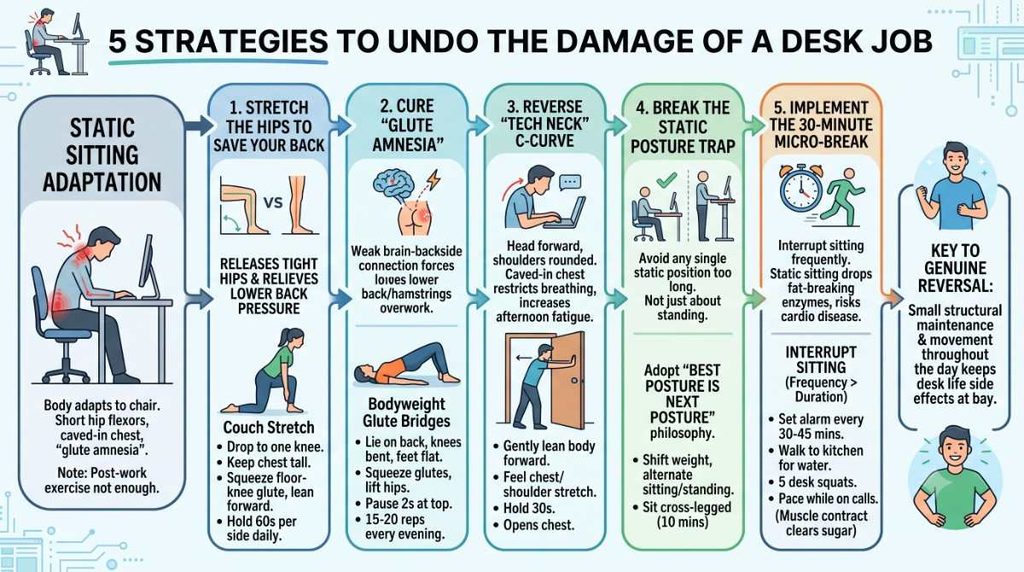
We often blame this on “getting older” or having a bad office chair. But the truth is much simpler: the human body is a highly adaptable machine. If you put it in a chair for eight to ten hours a day, it will physically adapt to the shape of that chair. Your hip muscles shorten, your chest caves in, and your glutes essentially forget how to work.
There is a common misconception that hitting the gym for an hour after work completely cancels out an entire day of sitting. In fitness circles, this is known as the “active couch potato” phenomenon. While a workout is fantastic for your heart and muscles, a brief evening sweat session doesn’t undo the structural tension built up from hours of hunching over a keyboard.
To genuinely reverse the wear and tear of a desk job, you have to directly counteract the specific physical habits of sitting. Here are five practical, highly effective ways to do exactly that.
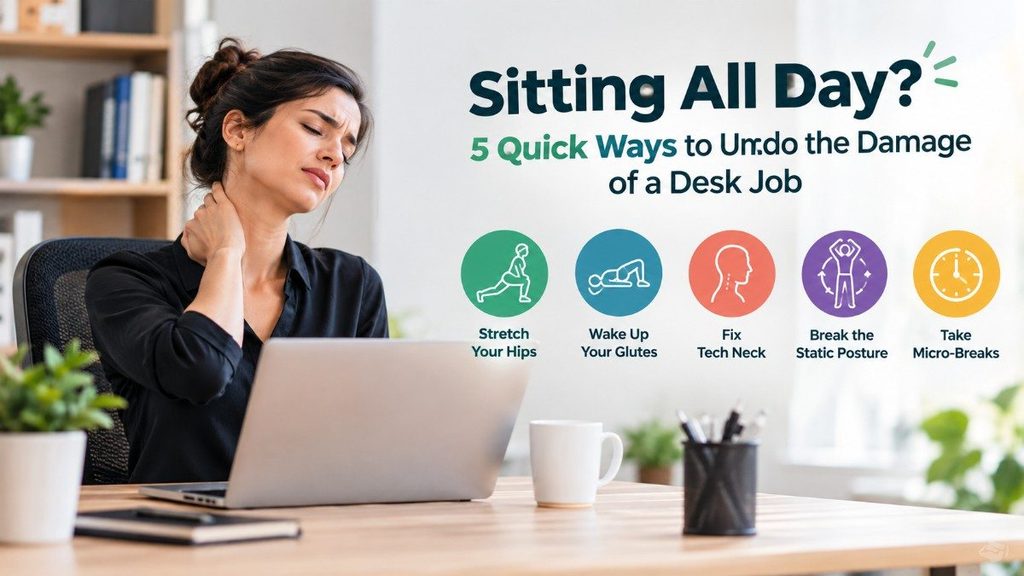
Table of Contents
Stretch the Hips to Save Your Back
When you sit, your legs are bent at a 90-degree angle. This keeps your hip flexors—the muscles connecting your legs to your torso—in a constantly shortened state. Over time, they tighten like a coiled spring. When you finally stand up, those tight hip flexors pull your pelvis forward, which instantly dumps a massive amount of pressure onto your lower back.
Most people with lower back pain from desk jobs don’t actually have a weak back; they have painfully tight hips.
How to fix it: Incorporate the half-kneeling hip flexor stretch (often called the couch stretch). Drop to one knee, keep your chest tall, and squeeze the glute of the knee that’s on the floor. Gently lean forward until you feel a deep stretch in the front of your hip. Hold this for 60 seconds on each side daily. It is arguably the single most important stretch for desk workers.
Cure Your “Glute Amnesia”
Your glute muscles are designed to be the largest, most powerful muscles in your body, responsible for keeping you upright and propelling you forward. But when you sit on them all day, they undergo something physical therapists casually call “glute amnesia.” Because they aren’t being used, the neurological connection between your brain and your backside weakens.
When your glutes stop doing their job, your lower back and hamstrings are forced to work overtime to stabilize your body.
How to fix it: You need to wake them up. Bodyweight glute bridges are perfect for this. Lie on your back with your knees bent and feet flat on the floor. Push through your heels and squeeze your glutes to lift your hips toward the ceiling. Pause at the top for two seconds, then lower back down. Do a quick set of 15-20 reps every evening to remind your body how to fire those muscles.
Reverse the “Tech Neck” C-Curve
Take a mental snapshot of your posture when you are deep into a work project. Chances are, your head is tilted forward toward the screen, your shoulders are rounded, and your upper spine looks like the letter “C.”
This forward head posture forces the muscles at the back of your neck to hold up the equivalent of a bowling ball all day. It also restricts your breathing. When your chest is caved in, your diaphragm cannot fully expand, leading to shallow breathing and, surprisingly, an increase in afternoon fatigue.
How to fix it: Use the doorway stretch to open up your chest. Stand in a doorway, place your forearms on the doorframe with your elbows at shoulder height, and gently lean your body forward. You should feel a stretch across your chest and the front of your shoulders. Hold for 30 seconds to reverse the forward-slumping posture.
Break the Static Posture Trap
A lot of people think buying a standing desk is the ultimate solution to sitting all day. But trading eight hours of static sitting for eight hours of static standing just swaps one set of problems for another, often leading to foot, knee, and vein issues.
The real enemy isn’t the chair. The enemy is staying in one position for too long.
How to fix it: Adopt the philosophy that “the best posture is your next posture.” Shift your weight. Alternate between sitting and standing if you have an adjustable desk. Sit cross-legged in your chair for ten minutes. The goal is to continuously change the mechanical load on your joints so no single muscle group gets overworked.
Implement the 30-Minute Micro-Break
When you sit entirely still, blood flow slows down, and the enzymes responsible for breaking down fat in your bloodstream drop sharply. This metabolic stagnation is why prolonged sitting is linked to higher risks of cardiovascular disease, even in people who exercise regularly.
How to fix it: Frequency matters more than duration. You don’t need a 20-minute break to see benefits; you just need to interrupt the sitting. Set a silent alarm on your phone or smartwatch to vibrate every 30 to 45 minutes. When it goes off, simply stand up. Walk to the kitchen for a glass of water, do five squats at your desk, or just pace around the room while taking a phone call.
Getting your muscles to contract briefly clears sugar from your bloodstream and hits the reset button on your metabolism.
You don’t have to quit your job or spend two hours doing yoga every night to feel better. Your body just needs a little structural maintenance. By opening up your hips, waking up your glutes, and simply giving yourself permission to fidget and move throughout the day, you can keep the worst side effects of desk life completely at bay.