
Spironolactone for Stroke Survivors: Benefits and Latest Research
Adding spironolactone—a low-cost generic diuretic prescribed for decades—to post-stroke care significantly improves home blood pressure control compared with standard treatment, according to clinical trial results presented at the American Heart Association (AHA) Scientific Sessions in November 2026. Controlling high blood pressure is the single most effective step to prevent a second stroke, yet many survivors struggle to reach target readings with conventional first-line pills alone. A common misconception is that spironolactone directly repairs damaged brain tissue or replaces standard stroke medications; in reality, it works by blocking a hormone that drives stubborn blood pressure and vascular stiffness, serving as an add-on therapy rather than a standalone cure.
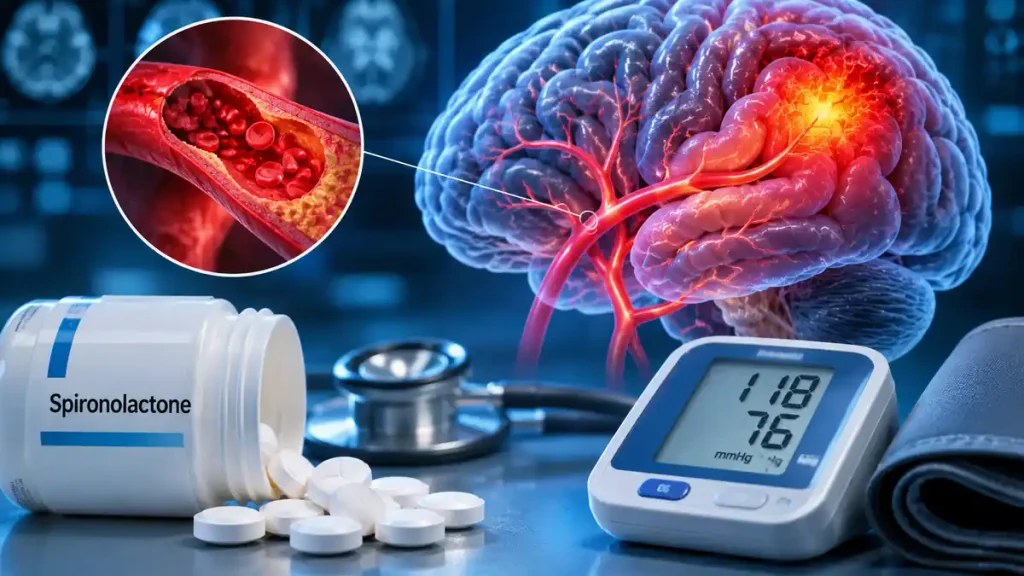
In the randomized REDUCE trial of 160 adult stroke survivors, adding daily spironolactone lowered home systolic blood pressure by an average of 7.7 mm Hg more than standard care at three months. More than half (52%) of patients taking spironolactone reached the recommended blood pressure target below 130/80 mm Hg, compared with 30% in the standard-care group. While serious hospitalization rates were similar between groups, spironolactone requires routine blood tests to monitor potassium and kidney function.
What the Latest Research Shows: Inside the REDUCE Trial
Interest in spironolactone for stroke recovery surged following late-breaking results from the REDUCE randomized controlled trial (NCT04760717), led by Dr. Jordana B. Cohen and presented at the AHA Scientific Sessions in November 2026. Because meeting abstracts represent preliminary data prior to full peer-reviewed journal publication, understanding the trial’s exact design and boundaries helps clarify what the findings mean for patients.
Researchers across five U.S. medical centers enrolled 160 adult stroke survivors (average age 63; 38% women; 29% Black adults; 16% Hispanic adults) between April 2021 and October 2025. Roughly half had survived an ischemic (clot-caused) stroke and half had survived a hemorrhagic (bleeding) stroke. All participants had uncontrolled high blood pressure at baseline, with an average home systolic reading of 136 mm Hg.
Participants were randomly assigned either to add daily spironolactone to their regimen or to receive standard post-stroke blood pressure management without spironolactone. Key results reported in the American Heart Association trial summary include:
- Greater systolic reduction at three months: Home systolic blood pressure averaged 125.6 mm Hg in the spironolactone group versus 133.3 mm Hg in the standard-care group—a mean difference of 7.7 mm Hg.
- Sustained six-month benefit: At six months, home systolic pressure remained 6.9 mm Hg lower on average with spironolactone (124.0 mm Hg vs. 130.9 mm Hg).
- Higher goal attainment: At three months, 52% of participants taking spironolactone achieved the guideline-recommended target below 130/80 mm Hg, compared with 30% receiving standard care.
- Stronger response in key subgroups: Exploratory analyses showed larger blood pressure drops among participants who started spironolactone within 90 days of their stroke and among those with a body mass index (BMI) of 30 kg/m² or higher.
What the Evidence Does and Does Not Show
While the blood pressure improvements in REDUCE are clear, the trial has important limits that patients and clinicians must weigh:
- It measured blood pressure, not second strokes: REDUCE was designed to test home blood pressure control over three to six months. It was not large or long enough to prove whether adding spironolactone directly reduces recurrent strokes, heart attacks, or death.
- Open-label design and medication count: Both doctors and patients knew who was taking spironolactone. By three months, people in the spironolactone group were taking slightly more total blood pressure pills on average (2.6 vs. 2.1), and enrollment ended early at 160 of the planned 200 participants.
- Findings do not apply to everyone: The trial excluded patients with moderate-to-severe kidney impairment (eGFR below 45), elevated baseline potassium, very low systolic pressure (below 120 mm Hg), or extremely high systolic pressure (above 200 mm Hg).
How Spironolactone Works After a Stroke
Most standard blood pressure drugs prescribed after a stroke—such as ACE inhibitors, angiotensin receptor blockers (ARBs), calcium channel blockers, and thiazide diuretics—relax blood vessels or flush excess fluid. Spironolactone belongs to a distinct class called mineralocorticoid receptor antagonists (MRAs).
It blocks aldosterone, a hormone produced by the adrenal glands that signals the kidneys to retain sodium and water while excreting potassium. Excess aldosterone activity is a major driver of resistant hypertension, especially in older adults and people with obesity or sleep apnea. By blocking aldosterone receptors, spironolactone helps the kidneys release excess sodium and water without depleting potassium. Earlier animal research, including preclinical studies in stroke-prone rats indexed on PubMed, also suggests that blocking aldosterone receptors may reduce blood vessel remodeling and inflammation, though human stroke care relies on the drug primarily for reliable blood pressure reduction.
Comparing Post-Stroke Blood Pressure Medications
Under the 2021 AHA/ASA Guideline for the Prevention of Stroke in Patients With Stroke and Transient Ischemic Attack, most stroke survivors with high blood pressure are advised to aim for an office reading below 130/80 mm Hg. Clinicians typically combine drugs from different classes to reach that goal.
| Medication Class | Common Examples | How It Lowers Blood Pressure | Key Electrolyte Effect | Typical Role After Stroke |
| ACE Inhibitors / ARBs | Lisinopril, losartan | Relaxes blood vessels by blocking angiotensin II | Can raise potassium | First-line foundation therapy |
| Thiazide-Type Diuretics | Chlorthalidone, hydrochlorothiazide | Removes excess sodium and fluid via kidneys | Can lower potassium | First-line foundation therapy |
| Calcium Channel Blockers | Amlodipine | Relaxes smooth muscle in arterial walls | Neutral on potassium | First-line or second-line add-on |
| Mineralocorticoid Receptor Antagonists | Spironolactone | Blocks aldosterone to shed sodium and fluid | Retains potassium (risk of high potassium) | Add-on for stubborn or resistant blood pressure |
Who Should Be Cautious or Avoid Spironolactone
Spironolactone is widely available as an inexpensive generic tablet, but it is not appropriate for every stroke survivor. According to the FDA prescribing information for Aldactone (spironolactone), specific medical conditions and drug combinations require close supervision or avoidance:
- Elevated blood potassium (hyperkalemia): Because spironolactone causes the body to hold onto potassium, it must not be used in people who already have high serum potassium. In the REDUCE trial, high potassium occurred in 4% of participants taking spironolactone versus 0% in the standard-care group; none caused life-threatening emergencies, but the risk requires routine lab checks.
- Reduced kidney function: Spironolactone is cleared through the kidneys. People with chronic kidney disease face a significantly higher risk of dangerous potassium spikes and worsening kidney function.
- Overlapping medications: Combining spironolactone with ACE inhibitors (like lisinopril), ARBs (like losartan), potassium supplements, potassium-based salt substitutes, or regular nonsteroidal anti-inflammatory drugs (NSAIDs such as ibuprofen or naproxen) compounds the risk of high potassium and kidney strain.
- Dizziness and low blood pressure: In REDUCE, low blood pressure (8% vs. 1%) and lightheadedness (5% vs. 1%) were more common in the spironolactone group. For stroke survivors with balance or mobility impairments, sudden drops in blood pressure upon standing can increase fall risk.
- Hormonal side effects and pregnancy: Spironolactone interacts with androgen and progesterone receptors, which can cause breast tenderness or enlargement (gynecomastia) in men and irregular menstrual cycles in women. It should be avoided during pregnancy.
Questions to Ask Your Doctor or Pharmacist
Never start, stop, or adjust any blood pressure prescription on your own—abruptly stopping antihypertensive therapy after a stroke can trigger dangerous rebound blood pressure spikes. If your home readings remain above 130/80 mm Hg, bring these questions to your next neurology or primary care appointment:
- Is my home blood pressure average consistently above my personal target? Ask what specific systolic and diastolic range is safest for your stroke subtype (ischemic vs. hemorrhagic) and artery health.
- Could adding a low dose of spironolactone help simplify or strengthen my regimen? Ask whether spironolactone makes sense alongside your current medications, especially if you already take two or three blood pressure drugs.
- When do I need blood work after starting or changing the dose? The FDA label recommends checking serum potassium and kidney function within one week of starting spironolactone or increasing the dose, and periodically thereafter.
- Which over-the-counter pain relievers and salt substitutes should I avoid? Confirm with your pharmacist whether you need to avoid ibuprofen, naproxen, or low-sodium salt substitutes containing potassium chloride.
Frequently Asked Questions
Does spironolactone prevent a second stroke on its own? No. Spironolactone does not replace antiplatelet drugs (like aspirin or clopidogrel), anticoagulants, or cholesterol-lowering statins recommended in the AHA/ASA secondary stroke prevention guidelines. Its benefit comes from lowering blood pressure, which is one pillar of reducing recurrent stroke risk.
How quickly does spironolactone lower blood pressure after a stroke? Blood pressure typically begins declining over the first few weeks of daily therapy, with full effects assessed over one to three months. In the REDUCE clinical trial, participants who began spironolactone within 90 days of their stroke experienced even larger reductions than those who started later.
What side effects should prompt a call to my doctor?Contact your care team promptly if you experience dizziness or lightheadedness when standing, muscle weakness, unexplained fatigue, nausea, or an irregular heartbeat, which can signal low blood pressure or rising potassium levels. Seek emergency care if you develop any new neurological symptoms such as facial drooping, arm weakness, or slurred speech.
Can I use potassium-based salt substitutes while taking spironolactone? No, unless your physician specifically approves them. According to the FDA Aldactone drug label, potassium supplements and high-potassium salt substitutes can push blood potassium to unsafe levels when combined with spironolactone.
Is eplerenone the same as spironolactone? Eplerenone belongs to the same medication class and blocks aldosterone without causing hormonal side effects like breast tenderness, though it is generally less potent per milligram for blood pressure and costs more. Taking spironolactone and eplerenone together is strictly contraindicated because of the severe risk of high potassium.