Why Your Face Stings When You Moisturize
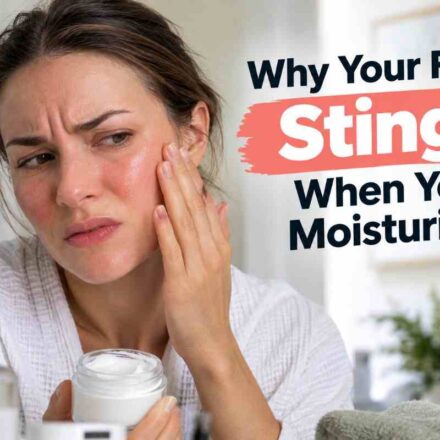
A gentle, bland cream goes onto your cheeks, and suddenly your face stings when you moisturize. Within three seconds, your skin feels like it is on fire.
You rush back to the mirror to check the label. Fragrance-free. Hypoallergenic. Dermatologist-tested. Formulated for ultra-sensitive skin. You have used this exact tub for six months without an issue.
The moisturizer is not the problem. Your skin barrier is broken.
When the outermost protective layer of your epidermis degrades, substances that normally sit harmlessly on the surface seep past your cellular defenses. They hit bare, reactive nerve endings in the upper dermis. The result is a sharp, stinging sensation that leaves people convinced they suddenly developed an allergy overnight.
Understanding why this happens—and how to stop applying products that quietly prolong the damage—is the only way to get your face back to baseline.

Table of Contents
What Actually Causes the Sting
Your stratum corneum functions like a brick wall. The “bricks” are your corneocytes (hardened, dead skin cells packed with keratin). The “mortar” is a matrix of natural lipids: roughly 50% ceramides, 25% cholesterol, and 15% free fatty acids.
When that mortar is intact, water stays locked inside your tissue, while environmental irritants, microbes, and cosmetic solvents stay locked out.
When you over-exfoliate, use high-pH cleansers, or tolerate dry winter radiator heat, that lipid mortar develops microscopic gaps. Transepidermal water loss (TEWL) surges. As the moisture evaporates, the skin contracts, forming micro-fissures.
Substances like glycols, preservatives (such as phenoxyethanol), and even humectants like plain hyaluronic acid can instantly slip through those fissures. They trigger the TRPV1 sensory receptors on your local nerve fibers. Those receptors register chemical entry the same way they register high heat or a chemical burn: immediate stinging.
Damaged Barrier vs True Allergic Reaction
People frequently confuse an impaired barrier with an active allergic reaction. Treating one like the other often leads to choices that make the situation worse.
| Indicator | Damaged Skin Barrier (Irritation) | Contact Allergy (Immunological) |
| Onset of Sensation | Instantaneous; hits within 5 to 30 seconds of application | Delayed; typically peaks 24 to 72 hours after exposure |
| Primary Sensation | Sharp stinging, prickling, or hot sensation that fades within minutes | Intense, persistent itchiness that does not settle |
| Physical Appearance | Diffuse redness, tight sheen, fine crepey texture, rough patches | Raised bumps, swelling around eyes or lips, small vesicles/blisters |
| Reaction to Water | Plain tap water stings or burns when splashing the face | Water feels neutral or soothing, though itching remains |
| Resolution | Improves within days of stopping active ingredients and resting | Requires removing the specific offending allergen entirely |
The Culprits That Tear the Mortar Down
Rarely does a barrier collapse overnight from a single bad product. It is almost always a slow erosion caused by stacking small habits together.
1. The Low-Grade Acid Trap
Using a 2% salicylic acid wash in the shower, swiping on an exfoliating toner with glycolic acid, and finishing with a 10% niacinamide serum feels like an active, results-driven routine. In reality, you are dissolving stratum corneum cell bonds faster than your basal layer can regenerate them. The skin ends up artificially thin, shiny, and defenseless.
2. Stripping Cleansers and Hot Water
If your face feels squeaky-clean or tight enough that smiling feels uncomfortable right after washing, your cleanser is too harsh. Foaming surfactants with an alkaline pH lift away your skin’s naturally acidic surface mantle (which should sit around pH 4.7 to 5.5). Hot water emulsifies your natural lipids and sends them down the drain.
3. Layering Pure Humectants in Dry Climates
Hyaluronic acid and glycerin are exceptional at binding moisture. However, they need water to hold onto. If you sit in an air-conditioned office or a heated apartment with low ambient humidity and apply a watery humectant without a rich occlusive over it, that serum will pull water up from the deeper layers of your dermis to hydrate the surface. It accelerates deep-tissue dehydration.
The 5-Day Barrier Reset
If your regular lotion stings on contact, throw out your multi-step routine. You cannot treat dullness, fine lines, or clogged pores while your epidermis is actively inflamed.
Step 1: Strip Down to Zero Actives
Put away every hydroxy acid, retinoid, pure vitamin C (ascorbic acid) bottle, clay mask, and textured washcloth. If it claims to brighten, exfoliate, tighten, or clear, it stays in the drawer for at least two weeks.
Step 2: Switch to Water-Rinsing or Non-Foaming Cleansers
Skip cleanser entirely in the morning; a lukewarm splash of water is plenty. In the evening, use an unfragranced, lotion-style cream cleanser that leaves a slight protective residue rather than a squeaky finish. Never scrub with a towel; pat dry gently.
Step 3: Choose Physiological Lipids Over Pure Oils
Slathering neat plant oils (like rosehip, coconut, or marula) onto broken skin often fails to repair the structural deficit. Pure oils are triglycerides. What your stratum corneum desperately requires to patch its barrier is an intentional balance of ceramides, physiological cholesterol, and free fatty acids. Look for moisturizers explicitly listing ceramides NP, AP, or EOP alongside phytosphingosine.
Step 4: Seal with an Inert Occlusive
If the stinging is intense, your skin needs an artificial seal while the cellular lipid synthesis catches up. A thin film of white petrolatum ointment applied over damp skin before bed cuts transepidermal water loss by over 98%. It is chemically non-reactive, cannot penetrate deeply enough to irritate exposed nerve endings, and provides the sheltered environment your skin cells require to rebuild.
When to Seek a Dermatologist
A burning sensation when applying moisturizer usually calms down within four to seven days of zero-active care.
If your skin remains hot to the touch, develops golden crusting, oozes fluid, or shows sudden pustules across your cheeks, you may be dealing with a secondary bacterial infection or an acute flare of rosacea or perioral dermatitis. Those conditions mimic barrier collapse but require targeted topical prescriptions rather than thick barrier creams, which can inadvertently trap heat and aggravate vascular reactivity. If gentle rest does not turn down the heat within a week, book a clinical evaluation.