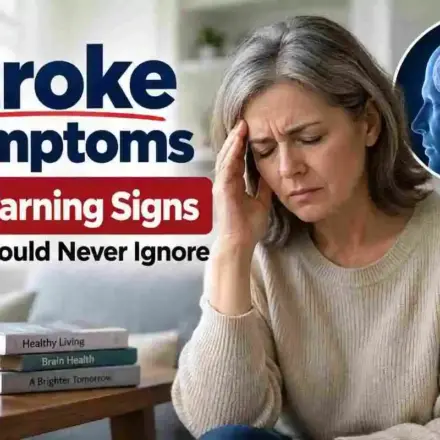
Stroke Symptoms: 7 Warning Signs You Should Never Ignore
A coffee cup slips from your fingers. You didn’t feel clumsy a second ago, but suddenly your right hand simply refuses to close.
When a stroke happens, it doesn’t wait for a convenient moment. It doesn’t build up over days like a head cold, and it rarely announces itself with the theatrical, chest-clutching agony people associate with heart attacks. It is quiet. It is clinical. It snips the connection between your brain and the rest of your body in fractions of a second.
About 1.9 million neurons die every minute an ischemic stroke goes untreated. That is why emergency medicine treats strokes with absolute urgency: the damage compounds by the second, and the window to reverse it shuts fast.

Table of Contents
Why Brain Emergencies Disguise Themselves
Most people dismiss early neurological deficits because they simply don’t hurt. A numb cheek gets blamed on sleeping wrong. Slurred words get written off as severe fatigue or low blood sugar.
A stroke is fundamentally a vascular interruption. Either a clot blocks oxygen-rich blood from feeding brain tissue (an ischemic stroke, making up roughly 87% of all cases), or a weakened vessel leaks directly into the cerebral parenchyma (a hemorrhagic stroke). Because different zones of the brain handle wildly distinct operations—motor control, spatial orientation, linguistic processing—no two strokes present identically.
Knowing the spectrum of dysfunction is what prevents people from sitting on the couch waiting for a catastrophic event to “wear off.”
The 7 Warning Signs You Cannot Afford to Brush Off
1. Sudden One-Sided Facial Sagging
The brain’s motor cortex sends symmetrical electrical signals to facial muscles. When blood flow drops in that territory, one pathway collapses. Ask the person to show their teeth or smile wide. If one corner of the mouth remains flat or droops downward, facial nerve signaling is failing.
2. Unilateral Limb Drifting or Numbness
It almost always picks a side. A stroke rarely creates symmetrical weakness in both arms at once. If you hold both arms straight out in front of you with palms up and eyes closed, one arm may involuntarily drift downward, rotate inward, or fail to lift entirely. That asymmetrical weakness points straight to motor pathway disruption.
3. Disrupted Language Processing (Aphasia or Dysarthria)
Speech problems manifest in two distinct ways during a stroke:
- Mechanical dysarthria: The tongue and palate muscles lose coordination, creating slurred, “thick-mouthed” syllables that sound like heavy intoxication.
- Cognitive aphasia: The speech-processing centers (Broca’s or Wernicke’s areas) lose oxygen. The person might string completely real words into nonsense phrases, or understand everything said to them while finding it impossible to summon a basic noun like “pen” or “shoe.”
4. Sudden Visual Field Cuts or Diplopia
Vision requires an astonishing amount of cerebral real estate, especially in the occipital lobes. A stroke can shear off your peripheral vision entirely on one side, meaning you might bump into doorframes or fail to notice an entire half of your plate. Alternatively, it can knock out the cranial nerves coordinating eye tracking, causing sudden, disorienting double vision without any optical pain.
5. Sudden Loss of Balance or Vestibular Failure
When an ischemic event targets the cerebellum or brainstem, the brain loses its internal gyroscope. This isn’t lightheadedness from standing up too fast. It is an abrupt, room-spinning vertigo accompanied by ataxia—an inability to place your feet in a straight line or keep your balance without clutching a wall.
6. The “Thunderclap” Headache
While ischemic strokes are often painless, hemorrhagic strokes regularly announce themselves with explosive intracranial pressure. Patients often call it the worst headache of their lives—a pain that reaches peak intensity within sixty seconds, frequently accompanied by neck stiffness or vomiting.
7. Abrupt Confusion and Spatial Neglect
Sometimes the sign isn’t physical weakness, but a sudden rupture in cognitive processing. A person might stop recognizing familiar surroundings, fail to acknowledge objects on their left side entirely, or look directly at family members with vacant bewilderment.
What Actually Happens in the Body: The Two Types
| Characteristic | Ischemic Stroke | Hemorrhagic Stroke |
| Root Cause | Thrombus or embolus blocking a cerebral artery | Ruptured arterial wall leaking blood into brain tissue |
| Typical Onset | Often sudden, but may be preceded by mini-strokes (TIAs) | Explosive, often accompanied by severe headache |
| Emergency Priority | Restoring blood flow via thrombolytics (clot-busters) or mechanical thrombectomy | Relieving intracranial pressure and controlling blood pressure |
| Time Criticality | Greatest benefit from clot-dissolving meds within 3 to 4.5 hours | Immediate intervention required to prevent herniation |
The Dangerous Trap of the “Mini-Stroke”
A Transient Ischemic Attack (TIA) produces the exact same symptoms as a full-blown stroke—a drooping smile, a paralyzed wrist, five minutes of garbled speech.
Then, the micro-clot dissolves on its own. The symptoms vanish. Normal sensation returns.
Many people sigh with relief and carry on with their week. That is a dangerous mistake. A TIA is an unstable vascular alarm bell; a significant percentage of people who experience a TIA suffer a major, disabling stroke within the following 48 hours. Medical evaluation at an emergency department is mandatory even if every symptom clears completely within minutes.
What to Do (And What to Avoid) When Symptoms Strike
If you observe any combination of these signs, do not wait.
- Call 911 immediately. Do not drive yourself, and do not drive a family member to the hospital in a personal vehicle. Paramedics begin stroke triage the second they arrive, routing you to a certified Primary or Comprehensive Stroke Center and notifying the neuro-interventional team before you even cross the hospital threshold.
- Note the exact “last known well” time. If someone woke up with symptoms, note the time they went to sleep. Emergency therapies like intravenous thrombolytics have strict therapeutic time windows.
- Do not give aspirin. If the stroke is hemorrhagic, aspirin acts as an antiplatelet agent and accelerates intracranial bleeding.
- Do not offer food, water, or medication. Stroke-induced pharyngeal weakness makes choking and aspiration pneumonia severe risks.
The brain does not regenerate lost tissue easily. Recognizing the signs early is the single most powerful factor determining whether someone leaves the hospital walking or facing months of intensive rehabilitation.